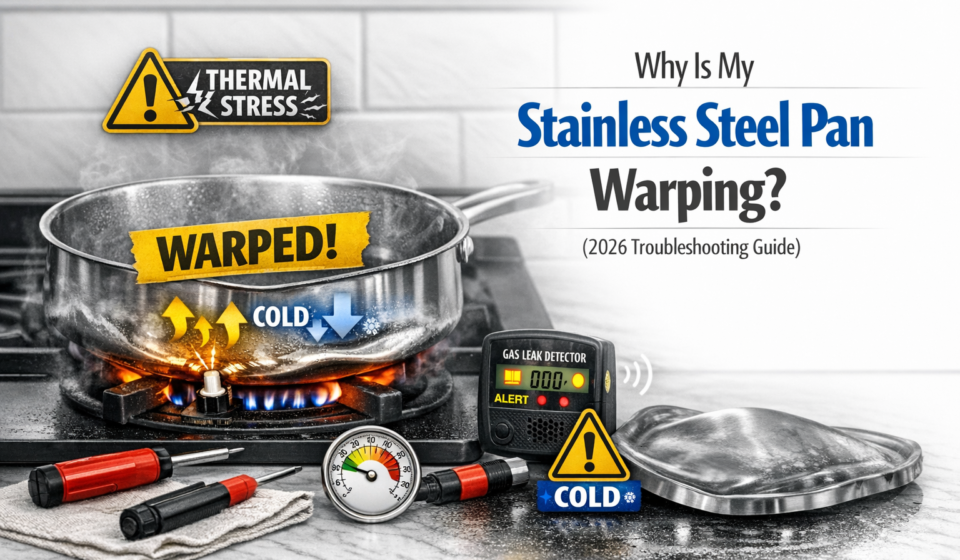

Why Is My Stainless Steel Pan Warping? (2026 Troubleshooting Guide)
A complete breakdown of thermal shock, construction quality, overheating, and how to prevent stainless steel pans from warping permanently
Stainless steel pans are known for durability — but even high‑quality cookware can warp under the wrong conditions. If your pan suddenly rocks on the stovetop, bulges in the center, or no longer sits flat, you’re dealing with warping, a common issue caused by rapid temperature changes or uneven heating.
This guide explains why stainless steel warps, how to diagnose the cause, whether it can be fixed, and how to prevent it from happening again.
1. What Warping Actually Is
Warping occurs when a pan’s metal layers expand or contract unevenly.
Stainless steel pans are usually multi‑ply:
- Stainless steel exterior
- Aluminum or copper core
- Stainless steel cooking surface
These layers expand at different rates when heated.
If one layer expands faster than the others → the pan bends.
Warping can be:
- Convex (domed) — pan spins or rocks
- Concave (sunken) — oil pools around the edges
- Twisted — pan wobbles unevenly
2. The Most Common Causes of Warping
2.1 Thermal Shock (The #1 Cause)
This happens when a hot pan is exposed to sudden cold.
Examples:
- Rinsing a hot pan under cold water
- Adding cold water to deglaze a scorching‑hot pan
- Placing a hot pan on a cold countertop
- Moving a pan from oven to cold sink
Why it happens:
- Hot metal expands
- Cold water contracts the metal instantly
- The layers pull in different directions
- The pan bends permanently
Thermal shock is responsible for 70–80% of warping cases.
2.2 Overheating the Pan
Stainless steel heats extremely fast — especially with an aluminum core.
Overheating occurs when:
- The burner is set to high with an empty pan
- The pan is left unattended
- Oil begins smoking heavily
- The pan reaches 600–900°F
At extreme temperatures, the metal layers expand unevenly, causing doming or twisting.
Signs of overheating:
- Rainbow discoloration
- Burnt oil residue
- Blue or bronze tint
- Loud popping sounds
2.3 Uneven Heating from the Burner
If the burner is smaller than the pan, the center overheats while the edges stay cool.
This causes:
- Center bulging
- Uneven cooking
- Hot spots
- Long‑term structural stress
Gas stoves with narrow flame rings are especially prone to this.
2.4 Poor Construction or Thin Cookware
Cheap stainless steel pans warp easily because they lack:
- Thick aluminum cores
- Even heat distribution
- Proper bonding between layers
Thin pans = fast expansion = fast warping
High‑quality tri‑ply or 5‑ply pans are far more resistant.
2.5 Sudden Temperature Drops from Food
Adding cold food to a very hot pan can shock the metal.
Examples:
- Frozen chicken
- Cold steaks
- Refrigerator‑temperature vegetables
This can cause the center to contract rapidly.
3. How to Tell If Your Pan Is Warped
Test 1: The Spin Test
Place the pan on a flat surface and try to spin it.
- Spins easily → convex warping
- Rocks back and forth → uneven warping
Test 2: The Oil Pool Test
Add a teaspoon of oil to the center.
- Oil runs to the edges → concave warping
- Oil pools in the center → convex warping
Test 3: The Light Gap Test
Place the pan upside down on a counter.
- Visible gaps → warped
- Even contact → normal
4. Can a Warped Stainless Steel Pan Be Fixed?
Short answer: Usually no.
Warping is a structural change in the metal layers. Once the layers have expanded or contracted unevenly, they cannot be reshaped without damaging the pan.
Exceptions (rare):
- Very mild warping
- Single‑ply stainless steel (no aluminum core)
- Professional metalworking tools
For multi‑ply cookware, replacement is the only reliable solution.
5. How to Prevent Warping (The Most Important Section)
5.1 Never rinse a hot pan with cold water
Let the pan cool for 5–10 minutes before washing.
5.2 Avoid overheating
Use medium or medium‑high heat for most cooking.
5.3 Preheat gradually
Start on low → increase to medium.
5.4 Match pan size to burner size
Burner should be at least 70% of the pan’s diameter.
5.5 Avoid adding cold food to a very hot pan
Let meat sit at room temperature for 10–15 minutes before cooking.
5.6 Don’t leave empty pans on high heat
Stainless steel can reach 700°F in under 3 minutes.
5.7 Use high‑quality multi‑ply cookware
Tri‑ply or 5‑ply pans resist warping far better than thin budget pans.
6. When to Replace a Warped Pan
Replace the pan if:
- It rocks or spins on the stovetop
- Oil pools unevenly
- Food cooks unevenly
- The warping worsens over time
- The pan no longer sits flat on induction
Warping affects:
- Heat distribution
- Browning
- Searing
- Safety on flat cooktops
7. Does Warping Affect Cooking Performance?
Yes — significantly.
Warped pans cause:
- Uneven heat
- Hot spots
- Poor searing
- Oil running to the edges
- Food sticking in the center
- Difficulty on induction cooktops
A warped pan can still be used for boiling or steaming — but not for searing, frying, or sautéing.
Conclusion
Stainless steel pans warp when exposed to thermal shock, overheating, or uneven heating — not because the material is weak. Warping is usually permanent, but it’s easy to prevent with proper heating, cooling, and cleaning habits. High‑quality multi‑ply cookware is far more resistant to warping, and with the right care, your stainless steel pans can last decades without losing their shape.