Why Is My Electric Stove Burner Not Heating Evenly? (2026 Troubleshooting Guide)

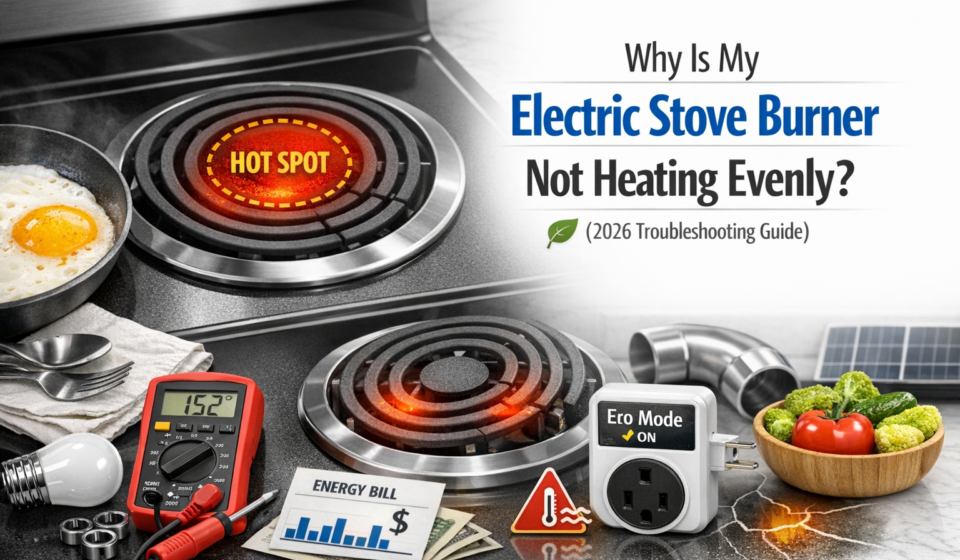
Why Is My Electric Stove Burner Not Heating Evenly? (2026 Troubleshooting Guide)
A complete breakdown of coil burners, radiant glass‑top elements, wiring issues, temperature sensors, and how to fix uneven heating at home
An electric stove burner that heats unevenly — hot on one side, cold on the other, slow to heat, or cycling erratically — is one of the most frustrating kitchen problems. Whether you have a coil burner, a glass‑top radiant burner, or a dual‑element burner, uneven heating almost always points to a mechanical, electrical, or surface‑contact issue.
This guide breaks down every cause of uneven heating, how to diagnose the problem, and the exact steps to fix it safely.
1. First: Identify Your Burner Type
Electric stoves use one of three heating systems:
1.1 Coil Burners (Exposed Coils)
- Visible metal coils
- Plug into a receptacle
- Most common in older or budget stoves
1.2 Radiant Burners (Glass‑Top Stoves)
- Heating element under a smooth glass surface
- Red glow when heating
- Most common in modern kitchens
1.3 Dual / Triple‑Zone Burners
- Multiple heating rings
- Allow small or large pan sizes
- Found on mid‑range and premium stoves
2. Why Coil Burners Heat Unevenly
Coil burners are simple — which makes diagnosing them easier.
2.1 Burner Not Seated Properly (Most Common Cause)
If the coil isn’t plugged in firmly, it won’t heat evenly.
Symptoms:
- One side hotter than the other
- Burner cuts in and out
- Burner wobbles or feels loose
Fix:
- Remove the coil
- Reinsert firmly into the socket
- Ensure it sits flat on the drip pan
2.2 Warped or Damaged Coil
Coils can warp from:
- Heavy pots
- Dropping cookware
- Overheating
Symptoms:
- Hot spots
- Uneven cooking
- Coil not sitting flat
Fix:
- Replace the coil (cheap and easy)
2.3 Dirty or Misaligned Drip Pan
If the drip pan is bent or misaligned, the coil won’t sit level.
Fix:
- Remove drip pan
- Clean or replace
- Ensure it sits flat in the stove cavity
2.4 Faulty Receptacle Block
The socket the coil plugs into can burn out.
Symptoms:
- Sparking
- Burn marks
- Intermittent heating
Fix:
- Replace the receptacle block
- Very common repair
3. Why Glass‑Top Radiant Burners Heat Unevenly
Glass‑top stoves are more complex — and more sensitive.
3.1 Uneven Contact Between Pan and Glass (Most Common Cause)
Glass‑top stoves require perfect pan contact.
Causes:
- Warped cookware
- Curved or domed pans
- Textured or uneven bottoms
Fix:
- Test pan flatness on a countertop
- Replace warped cookware
- Use flat‑bottom stainless steel or cast iron
3.2 Burned‑On Residue Under the Pan
Residue acts as insulation.
Symptoms:
- Hot spots
- Slow heating
- Brown or black marks on glass
Fix:
- Use a razor scraper
- Apply cooktop cleaner
- Remove all residue
3.3 Faulty Radiant Heating Element
The element under the glass can fail partially.
Symptoms:
- Only part of the burner glows
- Burner heats slowly
- Burner cycles too frequently
Fix:
- Replace the radiant element
3.4 Temperature Sensor Cycling Too Aggressively
Glass‑top burners use sensors to prevent overheating.
If the sensor is faulty:
- Burner turns on/off rapidly
- Heat never reaches full power
- Uneven cooking
Fix:
- Replace the limiter or sensor
3.5 Cracked or Damaged Glass Surface
Cracks disrupt heat distribution.
Fix:
- Replace the glass top (expensive but necessary)
4. Why Dual‑Zone Burners Heat Unevenly
Dual burners have multiple rings that can fail independently.
4.1 Inner or Outer Ring Failure
If one ring burns out:
- Only part of the burner heats
- Heat distribution becomes uneven
Fix:
- Replace the dual‑zone element
4.2 Incorrect Burner Size Selection
Using the wrong zone causes:
- Heat concentrated in the center
- Poor heat transfer
Fix:
- Match pan size to burner size
- Select the correct zone on the control knob
5. Electrical Issues That Cause Uneven Heating
5.1 Faulty Infinite Switch (Burner Control Switch)
This switch regulates power to the burner.
Symptoms:
- Burner stuck on low
- Burner surges unpredictably
- Burner cycles too often
Fix:
- Replace the infinite switch
5.2 Loose Wiring or Terminal Connections
Loose wires reduce power flow.
Symptoms:
- Weak heat
- Intermittent heating
- Hot spots
Fix:
- Tighten or replace wiring (professional recommended)
5.3 Voltage Issues in the Home
Electric stoves require 240V.
If voltage is low:
- Burners heat slowly
- Burners heat unevenly
Fix:
- Electrician checks the circuit
- Ensure dedicated 240V line
6. Cookware Problems That Mimic Burner Issues
Sometimes the burner is fine — the pan is the problem.
6.1 Warped Pans (Most Common Cookware Issue)
Warped pans = uneven contact = uneven heating.
Fix:
- Replace warped cookware
- Use heavier pans (stainless steel, cast iron)
6.2 Thin or Cheap Cookware
Thin aluminum pans create hot spots.
Fix:
- Upgrade to multi‑ply stainless steel
- Use cast iron for even heating
6.3 Oversized or Undersized Pans
Burner must match pan size.
7. How to Diagnose the Problem (Step‑by‑Step)
Step 1: Test with a known flat pan
If heat is even → cookware issue.
Step 2: Observe the burner glow pattern
Uneven glow → element issue.
Step 3: Check for residue on the glass
Clean thoroughly.
Step 4: Test burner cycling
Rapid cycling → sensor or switch issue.
Step 5: Swap burners (coil stoves only)
If the problem follows the burner → coil issue.
If it stays with the socket → receptacle or wiring issue.
8. When to Replace the Burner vs the Whole Stove
Replace the burner if:
- Only one burner is affected
- The element is visibly damaged
- The infinite switch is faulty
Replace the stove if:
- Multiple burners fail
- The glass top is cracked
- Wiring issues are widespread
- Repairs exceed 50% of replacement cost
Conclusion
An electric stove burner that heats unevenly is usually caused by improper pan contact, burner misalignment, damaged heating elements, faulty switches, or burned‑on residue. Coil burners are easy to fix at home, while glass‑top and dual‑zone burners may require replacing the radiant element or temperature limiter. With proper diagnosis and maintenance, your electric stove can heat evenly and reliably for years.