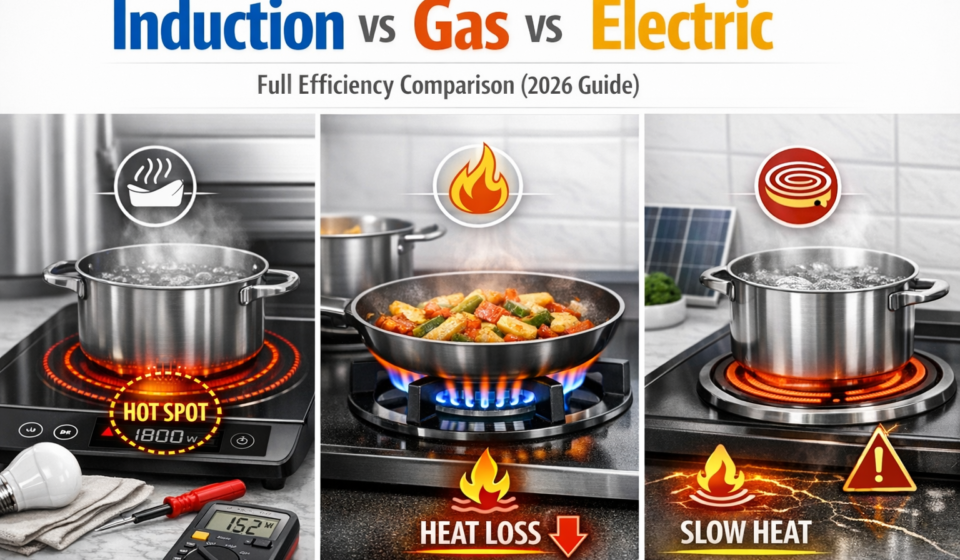

Induction vs Gas vs Electric: Full Efficiency Comparison (2026 Guide)
A complete breakdown of energy usage, cost per hour, heat efficiency, cooking performance, and long‑term savings
Choosing between induction, gas, and electric cooking isn’t just about preference — it’s about efficiency, cost, speed, and how much energy actually reaches your food. With rising utility prices and new 2026 appliance standards, homeowners are re‑evaluating which cooktop technology delivers the best performance for the lowest cost.
This guide compares all three technologies using real‑world cooking scenarios, energy usage data, and practical cost breakdowns.
1. How Each Cooking Method Works
1.1 Gas Cooking (Combustion Heat)
Gas stoves burn natural gas or propane to create an open flame.
Heat transfers to the pan through:
- Direct flame contact
- Radiant heat
- Hot air rising around the cookware
Gas is powerful but inefficient, losing most of its heat to the surrounding air.
1.2 Electric Cooking (Radiant or Coil Heat)
Electric stoves use resistance coils or radiant glass‑top elements.
Heat transfers through:
- A heated metal coil
- A glass surface
- Direct conduction into the pan
Electric is more efficient than gas but slower to adjust.
1.3 Induction Cooking (Magnetic Heat)
Induction uses a magnetic field to heat the pan directly — the cooktop surface stays relatively cool.
Heat transfers through:
- Electromagnetic induction
- Direct heating of the cookware itself
Induction is the most efficient and the fastest of all three.
2. Energy Efficiency Comparison (Heat Transfer Efficiency)
This measures how much of the energy actually reaches the food.
| Cooking Method | Efficiency | Notes |
|---|---|---|
| Induction | 85–90% | Most energy goes directly into the pan |
| Electric | 70–75% | Heat loss through glass and air |
| Gas | 35–40% | Most heat escapes around the pan |
Winner: Induction
Induction wastes almost no heat, making it the most efficient cooking method available.
3. Cost Per Hour Comparison (2026 Utility Rates)
Using U.S. average rates:
- Electricity: 17¢ per kWh
- Natural gas: $1.70 per therm
3.1 Gas Stove Cost Per Hour
A 12,000 BTU burner uses:
0.12 therms per hour → ~20 cents per hour
High‑power burner (18,000 BTU):
~31 cents per hour
3.2 Electric Stove Cost Per Hour
A 1,500W burner uses:
1.5 kWh → ~26 cents per hour
A large 2,500W burner:
2.5 kWh → ~42 cents per hour
3.3 Induction Cooktop Cost Per Hour
Induction burners typically use 1,800–2,200W, but because they cook faster and cycle less, real usage is lower.
Average cost:
18–28 cents per hour
4. Real‑World Cost Per Meal
Because induction cooks faster and wastes less heat, the real cost per meal is different from the cost per hour.
Assuming a 20‑minute cooking session:
| Cooking Method | Cost Per Hour | Cost Per Meal (20 min) |
|---|---|---|
| Induction | 18–28¢ | 6–9¢ |
| Electric | 26–42¢ | 9–14¢ |
| Gas | 20–31¢ | 7–10¢ |
Winner: Induction (lowest cost per meal)
Even though induction wattage is similar to electric, its speed and efficiency make it cheaper per use.
5. Speed Comparison (Boil Test)
Time to boil 1 liter of water:
| Cooking Method | Time |
|---|---|
| Induction | 2–3 minutes |
| Gas | 4–6 minutes |
| Electric | 6–8 minutes |
Winner: Induction
Induction is dramatically faster because it heats the pan directly.
6. Temperature Control & Cooking Performance
6.1 Induction
- Instant temperature changes
- Precise simmer control
- No wasted heat
- Best for professional‑level cooking
6.2 Gas
- Visual flame feedback
- Excellent for wok cooking
- Great for high‑heat searing
6.3 Electric
- Slow to heat
- Slow to cool
- Best for steady, even heat
7. Safety Comparison
| Feature | Induction | Electric | Gas |
|---|---|---|---|
| Surface stays cool | ✔️ | ❌ | ❌ |
| No open flame | ✔️ | ✔️ | ❌ |
| Auto‑shutoff | ✔️ | ✔️ | Limited |
| Indoor air quality | Excellent | Excellent | Poor (NO₂, CO) |
Winner: Induction
Induction is the safest option for homes, apartments, and small kitchens.
8. Environmental Impact
Gas
- Produces CO₂, NO₂, and CO
- Requires ventilation
- Contributes to indoor air pollution
Electric
- Cleaner than gas
- Efficiency depends on grid source
Induction
- Most energy‑efficient
- Lowest emissions when powered by renewable electricity
9. Upfront Cost & Installation
| Factor | Induction | Electric | Gas |
|---|---|---|---|
| Appliance cost | Highest | Moderate | Moderate |
| Installation | 240V outlet required | 240V outlet required | Gas line required |
| Operating cost | Lowest per meal | Moderate | Low per hour |
10. Which Cooktop Is Best Overall?
Best for Efficiency:
Induction
Best for Cost Per Hour:
Gas
Best for Cost Per Meal:
Induction
Best for Professional Cooking Feel:
Gas
Best for Safety:
Induction
Best for Budget Buyers:
Electric
Conclusion
In 2026, induction is the clear winner for efficiency, speed, safety, and overall cost per meal. Gas remains slightly cheaper per hour, but its heat loss and ventilation needs make it less efficient in real‑world cooking. Electric sits in the middle — reliable, consistent, and widely available.
For homeowners looking to reduce energy bills, improve indoor air quality, and cook faster, induction is the top choice.