
What is Fully-Clad Cookware? Ply Ratings Explained Simply
If you have ever spent time shopping for premium kitchenware, you have likely run into a wall of industrial-sounding marketing jargon. Product descriptions boast about “multi-ply bonding,” “tri-ply technology,” “5-ply commercial density,” and “fully cladded structural envelopes.” The price tags reflect this premium vocabulary, often ranging from $50 for a budget frying pan to over $250 for a luxury alternative.
For the beginner or intermediate home cook, this wall of technical specs can be overwhelming. It is easy to wonder: Is “fully-clad” just a clever marketing buzzword designed to inflate retail prices, or does it represent a genuine breakthrough in metallurgical engineering that changes how heat travels into food?
The short answer is that cladding is arguably the most important innovation in modern cookware history. Understanding the engineering behind it will save you from wasting money on poorly constructed pans that scorch your meals.
This comprehensive guide strips away the marketing hype to explain exactly what fully-clad cookware means, how multi-ply configurations alter the physics of cooking, and how to choose the perfect ply rating for your kitchen and budget.
The Core Problem: The Physics of Thermal Conduction
To understand why cookware needs to be “clad,” you must first look at the material science of metals. In an ideal world, a cooking surface needs to do three things flawlessly:
-
Heat Up Rapidly: It should react to adjustments on your stove dial instantly.
-
Distribute Heat Uniformly: It must eliminate hot spots so an egg cooks at the exact same speed in the center of the pan as it does along the perimeter.
-
Remain Chemically Inert: It should never leach metallic tastes or react chemically with acidic ingredients like tomatoes, wine, or lemon juice.
Unfortunately, no single metal in nature possesses all three of these characteristics.
+-------------------------------------------------------------------------+
|                  THE METALLURGICAL COOKWARE DILEMMA                     |
+-------------------------------------------------------------------------+
| STAINLESS STEEL:                                                        |
|   • Pros: Virtually indestructible, rust-proof, non-reactive.           |
|   • Cons: Terrible heat conductor; creates extreme, localized hot spots.|
|                                                                         |
| ALUMINUM & COPPER:                                                      |
|   • Pros: Spectacular heat conductors; distribute energy instantly.     |
|   • Cons: Highly reactive to acids; soft, warp-prone, and fragile.       |
+-------------------------------------------------------------------------+
If you construct a frying pan out of pure stainless steel, it will last forever, but it will conduct heat poorly. The area directly above your gas flame or induction coil will get blistering hot, while the rest of the pan remains cold, leading to unevenly scorched meals.
Conversely, if you build a pan out of pure, un-anodized aluminum, it will heat beautifully, but it will warp under high heat, scratch easily, and react with a tomato sauce to leach a metallic taste into your food.
The Solution: What Does “Fully-Clad” Actually Mean?
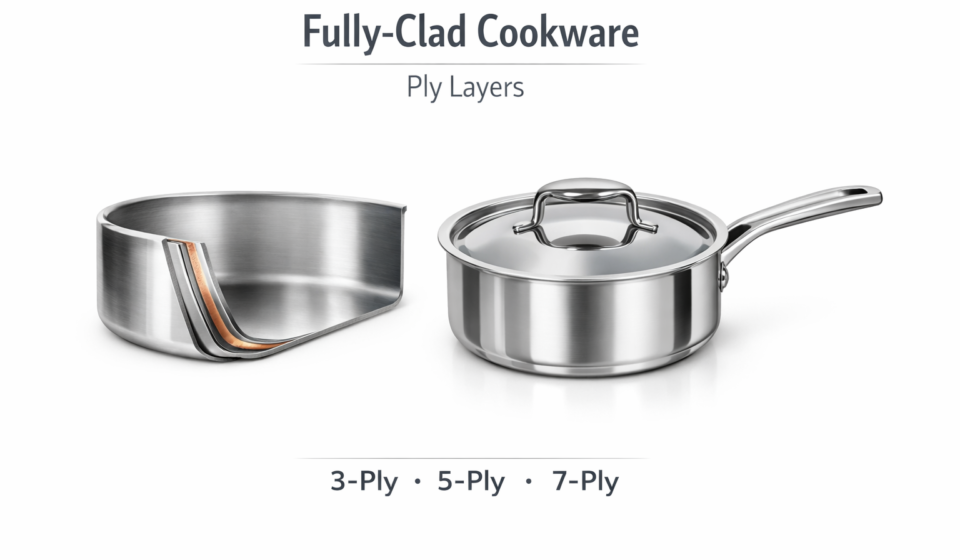
Cladding is the advanced metallurgical engineering solution to this dilemma. It is the process of permanently bonding sheets of highly conductive metals (like aluminum or copper) between sheets of non-reactive, durable metals (like stainless steel) under thousands of pounds of hydraulic pressure and extreme heat.
Think of a fully-clad pan as an engineered structural sandwich:
      [ Exterior Layer: Magnetic Stainless Steel (Induction Ready) ]
      [ Internal Core: High-Purity Conductive Aluminum/Copper      ]
      [ Interior Layer: 18/10 Surgical Grade Stainless Steel       ]
By bonding these distinct metals together into a single, composite sheet, manufacturers capture the best attributes of each material while eliminating their weaknesses. You get the rugged, safe, non-reactive cooking surface of high-grade surgical stainless steel, powered by the lightning-fast, perfectly uniform heat distribution of an internal aluminum or copper core.
The Critical Distinction: Fully-Clad vs. Impact-Bonded Bases
When browsing the cookware aisle, you will see many inexpensive stainless steel pans that look premium at first glance. However, there is a massive structural difference between a cheap “disc-bottom” pan and a true “fully-clad” pan.
-
Impact-Bonded Bases (Disc-Bottomed Cookware): The manufacturer builds a cheap, thin, single-ply stainless steel pan chassis. They then slap a thick, heavy disc of aluminum onto the very bottom of the pan. While this bottom disc distributes heat across the floor of the pan, that thermal distribution stops abruptly at the lower seam. The side walls of the pan remain thin, cold stainless steel.
-
Fully-Clad Cookware: The composite multi-layer sandwich of stainless steel and conductive aluminum runs continuously from the very center of the base, around the corners, and all the way up the side walls to the top rim of the pan.
Why Fully-Clad is Superior
In a disc-bottomed pan, food frequently scorches along the sharp inside corners where the floor meets the wall because the heat hits a wall of cold steel and drops off.
In a fully-clad pan, the entire vessel transforms into a uniform thermal envelope. The walls of the pan radiate heat into your food at the exact same temperature as the base. This provides total temperature control, making it virtually impossible for localized hot spots to ruin a delicate reduction or scorched grain.
Ply Ratings Explained Simply: 3-Ply vs. 5-Ply vs. 7-Ply
Once you decide to buy a fully-clad pan, your next choice centers on the ply rating. “Ply” simply refers to the individual layers of metal bonded together to form the pan’s body. Let’s deconstruct the common ply tiers simply so you can spot the differences.
+-----------------------------------------------------------------------+
|                    THE MULTI-PLY STRUCTURAL GRID                      |
+-----------------------------------------------------------------------+
| RATINGS   | LAYERS SPECS                  | PRIMARY CHARACTERISTIC     |
+-----------+-------------------------------+----------------------------+
| 3-Ply     | Steel - Aluminum - Steel      | Lightweight & Responsive   |
| 5-Ply     | Steel - 3x Alum/Cop - Steel   | Superior Heat Retention    |
| 7-Ply     | Steel - 5x Custom Core - Steel| Ultra-Dense Searing Power  |
+-----------+-------------------------------+----------------------------+
1. Tri-Ply (3-Ply) Cookware
Tri-ply is the classic, industry-standard configuration for premium clad cookware. It features a straightforward three-layer structure:
-
Interior Layer: 18/10 Stainless Steel (for non-reactive cooking)
-
Center Layer: Pure Aluminum (for rapid heat distribution)
-
Exterior Layer: Magnetic Stainless Steel (for structural durability and induction compatibility)
Performance Reality
Tri-ply pans strike a fantastic balance between weight, thermal efficiency, and price. Because they are relatively nimble, they heat up very quickly and respond instantly when you adjust your stovetop dial. If your sauce is getting too hot and you turn down the flame, a tri-ply pan sheds that excess heat quickly, preventing accidental burning.
2. 5-Ply Cookware
As home kitchens have become more advanced, 5-ply construction has grown increasingly popular. A 5-ply pan adds two additional layers of metal to the internal core sandwich. A typical configuration looks like this:
-
Interior Layer: 18/10 Stainless Steel
-
Core Layer 2: Pure Aluminum
-
Core Layer 3: Aluminum Alloy (or Copper)
-
Core Layer 4: Pure Aluminum
-
Exterior Layer: Magnetic Stainless Steel
Performance Reality
Adding more layers doesn’t necessarily mean the pan heats up five times faster. In fact, because a 5-ply pan has more physical metal mass, it actually takes longer to preheat than a 3-ply pan.
However, the benefit of 5-ply engineering is thermal retention and stability. Because the core is thicker and denser, it stores a massive reservoir of thermal energy. When you drop a cold, raw steak or a damp pork chop onto a hot 5-ply pan, the pan doesn’t experience a massive temperature drop. It maintains its high heat, allowing for a deep, golden, restaurant-grade crust that lighter pans struggle to replicate.
3. 7-Ply Cookware (And Beyond)
Reserved primarily for ultra-premium commercial applications or specialized induction lines, 7-ply cookware introduces an incredibly dense stack of alternating metal alloys, often combining titanium, silver, stainless steel, and multiple layers of aluminum or copper.
Performance Reality
For 95% of home cooks, 7-ply cookware is unnecessary. The added layers make the cookware exceptionally heavy, turning a simple task like tossing an omelet or pouring a sauce into a two-handed workout.
The primary utility of a 7-ply pan is extreme resistance to warping under commercial-grade heat, making it an excellent choice for high-power induction cooktops that generate immense magnetic stress.
The Ultimate Buyer’s Matrix: Which Ply is Right for You?
To make your purchasing decision as straightforward as possible, use this strategic blueprint to align your cooking style with the correct clad configuration.
Choose a 3-Ply Clad Skillet If:
-
You Value Responsiveness: You cook delicate meals like eggs, fish fillets, stir-fries, and reductions that require quick temperature adjustments.
-
You Prefer Lighter Cookware: You like to toss ingredients with a simple flick of your wrist without experiencing wrist fatigue.
-
You Want the Best Value: You want professional-grade thermal performance without crossing over into three-digit luxury price points.
Choose a 5-Ply Clad Skillet If:
-
You Love Searing Proteins: Your cooking style revolves around thick cuts of meat, cast-iron style searing, or high-volume batch frying.
-
You Cook on Glass-Top Induction or Electric: The added mass of a 5-ply base provides exceptional structural stability, ensuring the pan stays completely flat and doesn’t warp on rigid glass cooktops.
-
You Don’t Mind a Heavier Pan: You prioritize uniform thermal mass over quick, nimble handling.
3 Essential Maintenance Rules for Lifetime Durability
A fully-clad stainless steel pan is virtually indestructible from a structural standpoint. It has no synthetic plastic coatings to peel, flake, or degrade. If you treat it with respect, it will easily last your entire life and can be passed down to your children. Follow these three simple rules to keep your clad investment in pristine condition:
Rule 1: Let the Pan Cool Naturally Before Washing
When you complete a cooking session, never take a hot clad pan and plunge it immediately into a sink full of cold water. This triggers a violent physical event known as thermal shock.
Because stainless steel and aluminum expand and contract at completely different physical speeds when chilled rapidly, forcing a sudden temperature drop can cause the bonded layers to buckle, warp, or separate over time. Set the pan on a cool burner grate and let it cool down naturally for 10 minutes before getting it wet.
Rule 2: Learn to Clear “Rainbow” Heat Tints
After a few cooking sessions, you may notice a cloudy, multi-colored rainbow pattern forming on the interior floor of your stainless steel pan. Do not panic—this is not a defect or damage to the metal. It is a completely harmless layer of oxidized minerals known as a heat tint, caused by high-temperature exposure to atmospheric elements and cooking oils.
You cannot scrub a heat tint away with regular dish soap. Instead, splash a teaspoon of white vinegar or a sprinkle of a oxalic-acid cleaner (like Bar Keepers Friend) into the dry pan, wipe it gently with a damp sponge, and the rainbow discoloration will vanish instantly, restoring a brilliant mirror shine.
+-----------------------------------------------------------------+
|                    THE RAINBOW COLOR REVERSIBILITY              |
+-----------------------------------------------------------------+
| PROBLEM: Intense Heat + Minerals ===> Oxified Rainbow Tint       |
|                                                                 |
| SOLUTION: Mild Acid (Vinegar/Bar Keepers Friend) ===> Mirror Shine|
+-----------------------------------------------------------------+
Rule 3: Skip the Dishwasher
While manufacturers routinely label fully-clad cookware as “dishwasher safe,” keeping your premium steel out of the appliance is highly recommended.
Dishwashers expose cookware to incredibly harsh environments, combining abrasive detergents with intense, sustained heat cycles. Over months of exposure, these chemicals will pit and dull the polished exterior finish.
More importantly, the harsh spray can slowly corrode the exposed aluminum core along the rim edge where the cladding is visible. Hand washing a clad pan takes under two minutes because the smooth steel releases residue easily when soaked in warm, soapy water.
Summary: Elevate Your Culinary Potential
Investing in fully-clad cookware is one of the single most impactful decisions you can make to elevate your home cooking. By upgrading from cheap, single-ply pans or disc-bottomed alternatives to a continuous, multi-ply clad envelope, you take complete control over the thermodynamics of your stovetop.
+-------------------------------------------------------------------------+
|                    THE FULLY-CLAD INVESTMENT BLUEPRINT                 |
+-------------------------------------------------------------------------+
|  THE GEOMETRY:                                                          |
|  Insist on continuous cladding running from the base up to the side rim.|
|                                                                         |
|  THE SELECTION:                                                         |
|  • Go with 3-Ply for nimble responsiveness and daily value efficiency.  |
|  • Go with 5-Ply for maximum thermal mass and heavy-duty protein sears. |
+-------------------------------------------------------------------------+
You will no longer have to struggle with burned edges, cold spots, or warped pans. Whether you choose a nimble, highly responsive tri-ply pan or a heavy-duty, searing-focused 5-ply workhorse, you are choosing a professional, non-toxic tool that will reliably support your culinary journey for decades to come. Cook with precision, enjoy the uniform heat, and appreciate the difference that true engineering brings to your kitchen!