
Induction vs Gas Energy Efficiency: Which Stove Saves More Power and Money?
Introduction: The Modern Kitchen Energy Debate
The battle between induction and gas cooking isn’t just about style or speed — it’s about energy efficiency, cost, and sustainability. As homeowners look for ways to lower utility bills and reduce carbon footprints, the question becomes clear: Which is more efficient — induction or gas?
This guide breaks down how each system works, compares real‑world efficiency data, and shows how your cooking habits can make one option far more economical than the other.
1. How Induction and Gas Stoves Work
Induction Cooking
Induction stoves use electromagnetic energy to heat cookware directly. Instead of heating the air or the cooktop surface, induction transfers energy straight into the pan through magnetic fields.
Key traits:
- Instant heat transfer
- Precise temperature control
- Cool surface (no wasted heat)
- Requires magnetic cookware (stainless steel or cast iron)
Gas Cooking
Gas stoves burn natural gas or propane to create an open flame. The flame heats the cookware and surrounding air, which leads to some energy loss.
Key traits:
- Instant flame control
- Works with all cookware types
- Adds ambient heat to the kitchen
- Requires ventilation for combustion gases
2. Energy Efficiency Comparison
Induction Efficiency
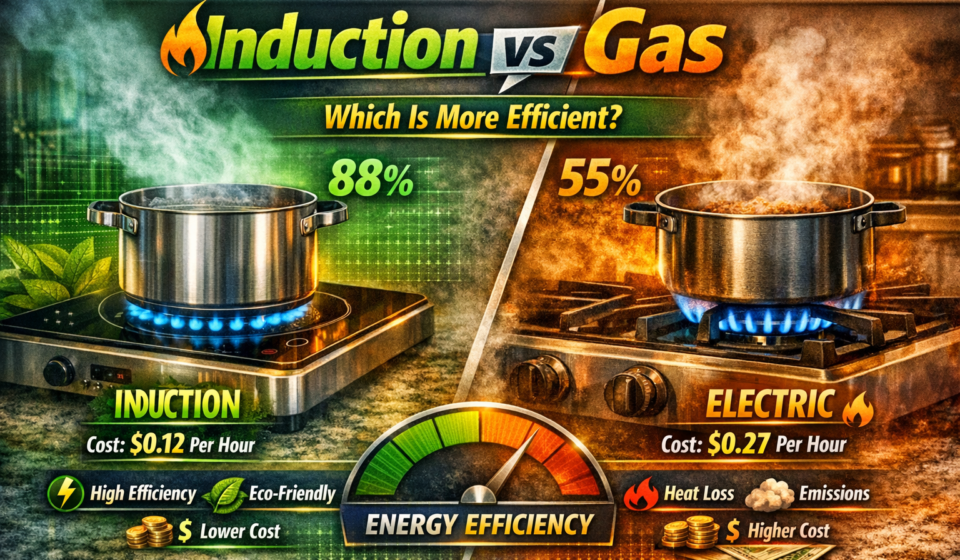
Induction stoves convert 85–95% of energy directly into heat for cooking.
Almost no energy is wasted because the pan itself becomes the heating element.
Gas Efficiency
Gas stoves convert only 40–55% of energy into usable heat.
The rest escapes as heat around the pan and into the air.
Efficiency Summary Table
| Stove Type | Energy Efficiency | Heat Loss | Notes |
|---|---|---|---|
| Induction | 85–95% | Minimal | Direct electromagnetic heating |
| Gas | 40–55% | High | Flame loses heat to air |
Verdict: Induction is nearly twice as efficient as gas.
3. Electricity vs Gas Cost (2026 U.S. Averages)
| Energy Type | Average Cost | Unit |
|---|---|---|
| Electricity | $0.15 per kWh | kilowatt‑hour |
| Natural Gas | $1.50 per therm | 100,000 BTUs |
At first glance, gas seems cheaper per unit — but efficiency changes the equation.
4. Real‑World Cost Comparison
Let’s compare the cost of cooking for 1 hour per day, 30 days per month.
Gas Stove
- Uses ~9,000 BTUs/hour = 0.09 therms
- Cost per hour:
[ 0.09 \times $1.50 = $0.135 ] - Efficiency: 50%
- Effective cost per hour:
[ $0.135 / 0.5 = $0.27 ]
Induction Stove
- Uses ~1.8 kWh/hour
- Cost per hour:
[ 1.8 \times $0.15 = $0.27 ] - Efficiency: 90%
- Effective cost per hour:
[ $0.27 / 0.9 = $0.30 ]
Result:
Costs are nearly identical — but induction uses half the energy to achieve the same cooking results.
5. Cooking Speed and Heat Control
Induction
- Heats pans in under 30 seconds
- Boils water twice as fast as gas
- Maintains precise temperatures for simmering or melting
Gas
- Heats slower due to flame dispersion
- Temperature control is manual and less precise
- Loses heat to air, making kitchens warmer
Efficiency takeaway: Faster cooking = less total energy used.
Induction wins again.
6. Environmental Impact
Gas Stoves
- Emit carbon dioxide (CO₂) and nitrogen oxides (NOₓ)
- Contribute to indoor air pollution
- Require ventilation to remove combustion gases
Induction Stoves
- No direct emissions
- Carbon footprint depends on electricity source
- Compatible with renewable energy (solar, wind)
Verdict: Induction is cleaner, greener, and safer for indoor air quality.
7. Kitchen Comfort and Heat Output
Gas stoves release significant radiant heat, raising kitchen temperatures by 5–10°F during extended cooking sessions.
Induction stoves transfer heat only to cookware, keeping the kitchen cooler and reducing air‑conditioning costs in summer.
Indirect Savings
Lower cooling demand = lower electricity bills.
Over a year, this can save $20–$50 in energy costs for frequent cooks.
8. Maintenance and Longevity
| Feature | Induction | Gas |
|---|---|---|
| Cleaning | Easy (flat surface) | Moderate (burners, grates) |
| Durability | 10–15 years | 15–20 years |
| Safety | Auto shut‑off, cool surface | Open flame risk |
| Ventilation | Not required | Required for combustion gases |
Induction wins for convenience and safety, while gas wins for lifespan.
9. Regional Cost Differences
Energy prices vary by state, which affects efficiency economics.
| Region | Electricity Rate | Gas Rate | Winner |
|---|---|---|---|
| California | $0.28/kWh | $1.90/therm | Gas |
| Texas | $0.13/kWh | $1.40/therm | Induction |
| New York | $0.22/kWh | $1.60/therm | Gas |
| Florida | $0.15/kWh | $1.80/therm | Induction |
| Washington | $0.11/kWh | $1.60/therm | Induction |
In states with cheap electricity or renewable incentives, induction becomes the clear winner.
10. Long‑Term Cost Outlook (2026–2030)
Energy analysts project:
- Natural gas prices rising 3–5% annually
- Electricity prices rising 2–3% annually
- Induction technology becoming cheaper and more widespread
By 2030, induction stoves may match or beat gas in total cost of ownership.
11. Practical Tips to Maximize Efficiency
For Induction Users
- Use flat‑bottomed magnetic cookware
- Match pan size to burner size
- Avoid thin or warped pans
- Keep cooktop clean for optimal sensor contact
For Gas Users
- Keep burners clean and properly aligned
- Use lids to trap heat
- Match flame size to pan diameter
- Avoid cooking on high heat unnecessarily
Small habits can improve efficiency by 10–20%.
12. Safety and Health Considerations
Induction
- No open flame
- Auto shut‑off when pan removed
- Cool surface prevents burns
- No combustion gases
Gas
- Open flame risk
- Emits carbon monoxide and nitrogen dioxide
- Requires ventilation
- Can trigger respiratory irritation in sensitive individuals
For households with children or allergies, induction is the safer choice.
13. Summary Comparison Table
| Feature | Induction | Gas |
|---|---|---|
| Efficiency | 85–95% | 40–55% |
| Cost per Hour | $0.27 | $0.27 |
| Cooking Speed | Faster | Slower |
| Environmental Impact | Clean | Emits CO₂ |
| Safety | Excellent | Moderate |
| Kitchen Heat | Low | High |
| Maintenance | Easy | Moderate |
| Best For | Energy savings, safety | Traditional cooking style |
Conclusion: The Clear Winner
When it comes to energy efficiency, induction cooking dominates.
It converts nearly all power into usable heat, cooks faster, and keeps your kitchen cooler — all while reducing emissions and improving safety.
Gas still appeals to traditional cooks who love flame control, but for modern kitchens focused on efficiency, sustainability, and cost savings, induction is the smarter long‑term choice.