
Induction vs. Gas: Which Cookware Do You Actually Need for Your New Range?
Upgrading your kitchen with a brand-new, premium range is one of the most exciting milestones a home cook can achieve. But once the initial excitement wears off and your new appliance is beautifully installed, a practical reality sets in: your old cookware collection might not be ready for the change.
If you have transitioned from an old-school electric coil stove to a modern, high-efficiency induction range, or if you have finally realized your dream of installing an open-flame professional gas cooktop, you are dealing with two completely different methods of heat transfer. Cookware that performed beautifully on a gas flame can completely fail to register on an induction cooktop. Conversely, a pan designed to maximize induction efficiency can feel clunky and unresponsive on a high-output gas burner.
Choosing the wrong cookware doesn’t just result in poorly cooked meals; it can lead to scratched appliances, warped pans, massive energy waste, and endless kitchen frustration.
This comprehensive guide will break down the fundamental physics of induction and gas cooking, analyze how the five major cookware materials behave on each platform, and help you determine exactly which pots and pans you need to purchase for your new range.
The Underlying Physics: How Gas and Induction Heat Your Food
To understand why a pan succeeds or fails on your new stovetop, you must understand the science of how that stovetop creates thermal energy. The difference between gas and induction is not just a matter of flame vs. glass—it is a fundamentally different approach to thermodynamics.
+-----------------------------------------------------------------+
|                   THERMAL ENERGY PROFILE DIRECTORY              |
+-----------------------------------------------------------------+
| GAS COOKTOP:                                                    |
|  Source: Open Flame Combustion                                  |
|  Mechanism: Thermal Radiation -> Conductive Base -> Sidewalls    |
|  Environment: Ambient Heat Escapes up the Sides                 |
|                                                                 |
| INDUCTION COOKTOP:                                              |
|  Source: Alternating Magnetic Field                             |
|  Mechanism: Magnetic Friction -> Heat Generated INSIDE the Pan   |
|  Environment: Ambient Air and Glass Stay Cool                   |
+-----------------------------------------------------------------+
Gas Cooking: Thermal Radiation and Ambient Wrap
Gas cooking is a traditional form of thermal radiation. When you ignite a gas burner, chemical combustion creates an open flame. This flame transfers raw heat energy directly to whatever object sits above it through conduction.
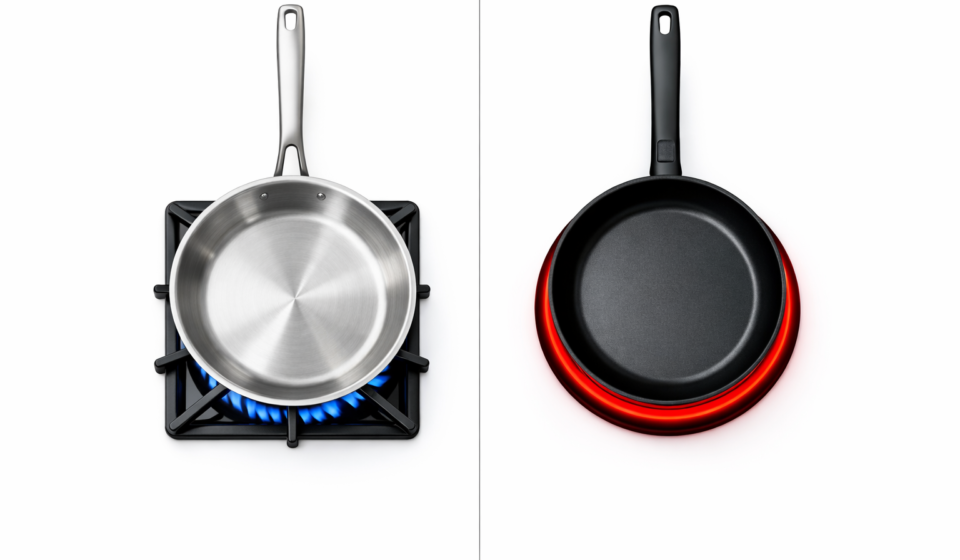
Because a gas flame is dynamic and fluid, it expands to fill the space it occupies. The flame licks across the bottom of the pan and wraps around its curved edges, heating not just the base floor of the cookware, but the outer vertical walls as well. This ambient heat wrap creates a very forgiving environment for pans that aren’t perfectly flat, but it also releases a massive amount of excess thermal energy into your kitchen air.
Induction Cooking: Magnetic Friction
Induction cooking completely eliminates the middleman of an external heat source. An induction cooktop features a completely flat, smooth ceramic glass top. Beneath that glass sits a densely wound coil of copper wire.
When you turn a burner on, an alternating electrical current passes through the copper coil, creating a dynamic electromagnetic field that radiates just above the glass surface.
When you place a compatible pan onto that zone, the magnetic field passes through the glass and penetrates the metal base of the pan. This magnetic field forces the iron electrons inside your cookware to rapidly vibrate back and forth billions of times a second. This intense molecular friction generates heat directly inside the metal matrix of the pan itself.
The glass surface doesn’t heat the pan; the pan heats the glass. If there is no pan on the burner, or if the pan lacks magnetic properties, the cooktop remains completely cold to the touch.
The Master Cookware Compatibility Breakdown
Because these two cooking platforms generate heat so differently, certain cookware materials naturally thrive on one system while struggling on the other. Let’s look at how the five primary kitchen metals handle the transition.
+-----------------------------------------------------------------------+
|                    MATERIAL COMPATIBILITY SCORECARD                   |
+-----------------------------------------------------------------------+
| MATERIAL              | GAS COMPATIBILITY      | INDUCTION COMPATIBLE |
+-----------------------+------------------------+----------------------+
| Fully-Clad Stainless  | Exceptional            | Yes (Check Magnet)   |
| Cast Iron (Raw/Enam)  | Outstanding            | Exceptional          |
| Carbon Steel          | Excellent              | Exceptional          |
| Pure Aluminum/Copper  | Exceptional            | Absolute No          |
| Ceramic Non-Stick     | Good                   | Only with Steel Plate|
+-----------------------+------------------------+----------------------+
1. Fully-Clad Multi-Ply Stainless Steel
Multi-ply stainless steel (such as premium pans from All-Clad, Made In, or Demeyere) features an aluminum or copper core sandwiched tightly between protective layers of stainless steel.
-
On Gas: Fully-clad stainless steel is a superstar on gas ranges. Because gas flames can create uneven hot spots, the internal aluminum or copper core works instantly to draw that raw thermal energy and distribute it uniformly across the pan. The multi-ply cladding extends all the way up the sides of the pan, allowing the ambient heat from the gas flame to keep the sidewalls hot for perfect pan-sauce reductions.
-
On Induction: Premium clad stainless steel performs flawlessly on induction, provided the exterior bottom layer is magnetic. Modern cookware manufacturers specifically utilize magnetic 430-grade stainless steel for the exterior shell of their pans to ensure induction compatibility. When shopping, always look for the “induction-compatible” spiral symbol stamped onto the bottom of the pan, or bring a standard refrigerator magnet to the store—if it sticks firmly to the bottom base, the pan will work.
2. Traditional Cast Iron & Enameled Cast Iron
Whether you love a rugged, black Lodge skillet or a luxury, enameled Le Creuset Dutch oven, cast iron is a heavyweight kitchen staple.
-
On Gas: Cast iron is beautifully matched for gas. Gas grates are rugged, rough, and industrial, meaning you can slide, slam, and adjust heavy iron pans without worrying about damaging your stove. Cast iron absorbs the fluctuating heat of an open flame and stores it like a battery, delivering an incredibly uniform, hard sear to steaks and chops.
-
On Induction: Cast iron is highly magnetic, making it one of the most efficient materials you can use on an induction range. It registers the electromagnetic field instantly and stays incredibly hot. However, you must change your physical habits. Because induction cooktops are made of smooth ceramic glass, dropping a heavy cast iron pan or dragging its rough, textured base across the surface can easily scratch or shatter the glass top. You must learn to lift instead of slide.
3. Lightweight Carbon Steel
Carbon steel combines the high-heat seasoning properties of cast iron with the thin, responsive geometry of a French chef’s skillet.
-
On Gas: Carbon steel is a darling of restaurant kitchens because it thrives on high-output gas flames. It responds to flame adjustments instantly and its flared sides are specifically designed for high-velocity flipping and sautéing over fire.
-
On Induction: Because carbon steel contains a high volume of ferrous iron, it acts as a magnet and performs spectacularly well on induction. In fact, because induction generates heat uniformly within the flat bottom base of the steel, it creates a highly predictable, ultra-slick non-stick surface for eggs and fish. Just ensure you preheat the pan slowly on medium heat; because carbon steel is thin, blasting it on high induction power instantly can cause the base to warp.
4. Pure Aluminum and Copper Cookware
Uncoated aluminum pans (like commercial baking sheets or cheap restaurant fry pans) and traditional luxury solid copper pots are favored for their incredible thermal conductivity.
-
On Gas: Copper and aluminum are unmatched on a gas flame. They conduct heat so rapidly that hot spots are eliminated instantly. If you lower the gas flame, the pan’s temperature drops within a single second, giving you absolute culinary control over delicate sauces and confections.
-
On Induction: They will not work at all. Aluminum and copper are non-ferrous metals, meaning they lack magnetic properties. If you place a pure copper pan onto an induction burner, the electromagnetic field will pass right through the metal without exciting any electrons. The stove will simply blink an error code and turn itself off. If you want to use copper or aluminum on induction, you must buy specialty pans that feature an integrated magnetic stainless steel base plate bonded onto the bottom.
5. Non-Stick and Ceramic Cookware
Standard daily-use skillets coated in traditional PTFE (Teflon) or eco-friendly ceramic gels are typically built on an aluminum chassis.
-
On Gas: These pans operate safely on gas as long as you keep the heat to medium or low. High gas flames can wrap around the edges, blistering the exterior non-stick paint and degrading the chemical coating prematurely.
-
On Induction: You must inspect the base. Because the core of these pans is non-magnetic aluminum, they require a bonded, perforated steel disc attached to the bottom to function on induction. Look at the underside of the pan: if you see a silver, dimpled metal plate stamped into the bottom, it is induction-compatible. Be aware, however, that budget non-stick pans with thin bonded plates can buzz or hum loudly when exposed to high induction settings due to the magnetic vibrations.
4 Critical Rules for Choosing Cookware Based on Your New Range
Now that you understand how materials react, let’s establish four rules to guide your purchasing decisions so you can curate the ultimate collection for your specific appliance.
Rule 1: The Induction “Flat-Bottom” Mandate
Because induction relies on proximity to an internal copper coil, the bottom of your cookware must be perfectly flat.
If a pan features a warped base, a severe ring ridge, or a deeply hammered texture, an air gap is created between the glass and the metal. The magnetic field drops off significantly over just a few millimeters of distance. A warped pan will either heat unevenly, vibrate loudly, or fail to trigger the stove’s internal sensors completely.
On a gas range, a warped or rounded pan is a non-issue. The fluid flame simply dances upward to meet the metal wherever it sits, meaning old, slightly bowed heirloom skillets or rounded Asian woks can perform perfectly over fire.
+-----------------------------------------------------------------+
|                  STOVETOP CONTRAST ARCHITECTURE                 |
+-----------------------------------------------------------------+
| INDUCTION REQUIREMENT:                                          |
|   [Cookware Base] === Must Be Perfectly Flat === [Glass Top]   |
|   Result: Unbroken magnetic contact, maximum efficiency.        |
|                                                                 |
| GAS UTILITY:                                                    |
|   [Cookware Base] ~~~ Dynamic Fluid Flame ~~~ [Gas Grate]       |
|   Result: Accommodates warped pans, woks, and rounded bases.    |
+-----------------------------------------------------------------+
Rule 2: Shape and Burner Matching
Induction cooking zones are binary: the magnetic field only exists directly within the perimeter of the designated burner ring printed on the glass. If you place a massive 12-inch cast iron skillet over an 8-inch induction ring, only the inner 8 inches of the iron will generate heat. The outer 4 inches will stay relatively cool until conduction slowly pulls heat outward over time.
On gas, matching the burner size is far more forgiving. A gas flame can expand outwards or be turned up to widen its circumference, allowing a small burner to effectively heat a larger pan base through natural flame distribution.
Rule 3: Ergonomics and Cooking Technique
Think about how you physically manipulate food while cooking.
-
The Gas Flippers: If you love to aggressively shake your pan, slam it down onto cooktop grates, or tilt the pan to spoon hot fat over a basting steak, Gas welcomes this physical, high-contact style.
-
The Induction Gliders: Induction requires a more gentle, stationary cooking technique. Shaking a pan aggressively back and forth can severely scratch or micro-fracture your glass cooktop. If you lift a pan too high off the induction surface to flip food, the magnetic connection breaks instantly, turning the burner off until you return it to the glass.
Rule 4: The Sound Factor
If you value a completely silent kitchen, your range choice dictates your cookware quality. Gas ranges are completely silent aside from the gentle, comforting hiss of burning fuel.
Induction ranges can generate noise when paired with multi-piece or budget cookware. When the intense electromagnetic field vibrates the metal layers of a clad pan or a non-stick pan with a bonded base, it can create a high-pitched humming, buzzing, or clicking sound. This is completely normal physics, but it means induction users must invest in heavier, single-piece cast pans or high-quality, securely bonded multi-ply cookware to minimize noise.
Summary: Your Ultimate Shopping Blueprint
To summarize exactly what you need to purchase for your new range, use this final checklist:
-
If you bought an Induction Range: Your priority is magnetism and flatness. Focus your budget on high-quality fully-clad multi-ply stainless steel sets with stamped magnetic bases, heavy cast iron or enameled Dutch ovens for high-heat searing, and ensure any daily-use non-stick cookware features a flat, heavy-duty integrated steel plate. Banish pure copper, raw aluminum, and old warped pans from your layout.
-
If you bought a Gas Range: Your priority is thermal conductivity and rugged durability. You can use virtually any metal on earth. Maximize your setup with highly responsive carbon steel skillets, stunning solid copper pots for delicate sauces, and heavy cast iron for unyielding sears. Don’t worry about perfectly flat bases or magnetic properties—focus entirely on comfortable handles and shape utility.
By matching the physical properties of your cookware materials to the exact thermal mechanics of your new range, you will unlock the true operating potential of your kitchen investment and enjoy a seamless, high-performance cooking experience for years to come!