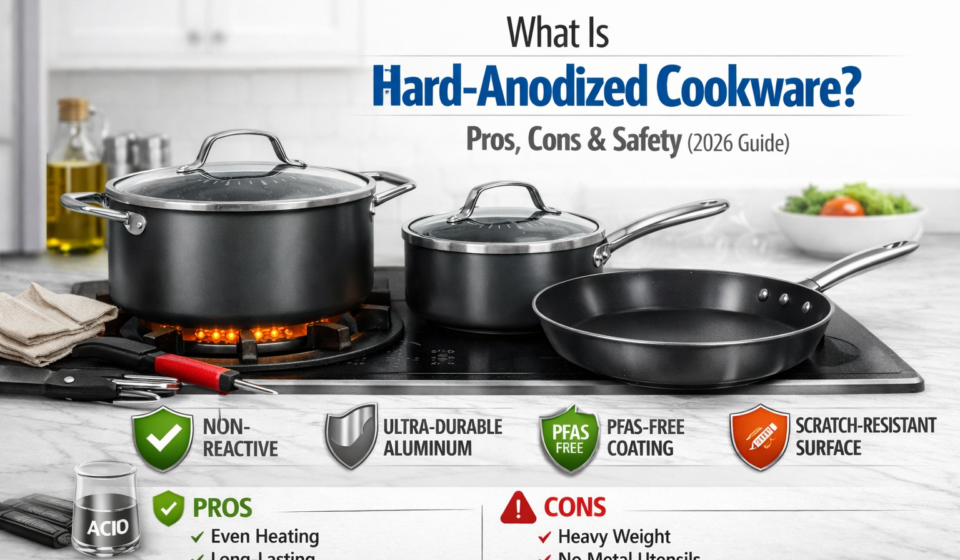

What Is Hard‑Anodized Cookware? Pros, Cons & Safety (2026 Guide)
A complete breakdown of how hard‑anodized cookware is made, why it’s so durable, how it compares to stainless steel and nonstick, and whether it’s safe to use
Hard‑anodized cookware has become one of the most popular choices for home cooks and professionals because it combines durability, even heating, and natural nonstick performance. But many people still don’t understand what “anodized” actually means — or whether aluminum‑based cookware is safe.
This guide breaks down how hard‑anodized cookware is made, why it’s stronger than regular aluminum, how it performs in real kitchens, and what you need to know about safety in 2026.
1. What Hard‑Anodized Cookware Actually Is
Hard‑anodized cookware starts as raw aluminum, which is then put through an electrochemical process called anodization.
The anodization process:
- Aluminum is submerged in an acid bath
- An electrical current passes through it
- The surface oxidizes and hardens
- A thick, protective layer forms
This hardened layer is:
- 2–3× stronger than stainless steel
- Non‑reactive
- Scratch‑resistant
- Corrosion‑resistant
Key point:
The anodized layer seals the aluminum, preventing it from leaching into food.
2. Why Hard‑Anodized Cookware Is So Popular
2.1 Extremely durable
The anodized surface is harder than stainless steel and resists:
- Scratches
- Dents
- Warping
- Corrosion
2.2 Naturally nonstick
The anodized layer has a smooth, low‑friction surface.
Most brands add a PTFE coating on top for extra slickness.
2.3 Heats evenly
Aluminum is one of the best heat conductors, so hard‑anodized pans:
- Heat quickly
- Distribute heat evenly
- Reduce hot spots
2.4 Lightweight
Much lighter than cast iron or stainless steel.
2.5 Affordable
Premium performance without premium pricing.
3. Is Hard‑Anodized Cookware Safe? (2026 Research)
Yes — hard‑anodized cookware is considered very safe.
Here’s why:
3.1 The anodized layer prevents aluminum exposure
The hardened surface is:
- Non‑reactive
- Non‑porous
- Chemically stable
Food never touches raw aluminum.
3.2 It doesn’t flake or peel
Unlike some coatings, the anodized layer is part of the metal itself.
3.3 It’s safe for acidic foods
Tomatoes, citrus, vinegar — all safe because the surface doesn’t react.
3.4 PTFE coatings (if present) are PFOA‑free
Modern PTFE is safe when used below 500°F.
3.5 Dishwasher safety varies
Some brands are dishwasher‑safe, but hand‑washing extends lifespan.
4. Hard‑Anodized vs Other Cookware Materials
4.1 Hard‑Anodized vs Stainless Steel
| Feature | Hard‑Anodized | Stainless Steel |
|---|---|---|
| Heat conduction | Excellent | Moderate |
| Nonstick ability | High | Low |
| Durability | Very high | Very high |
| Weight | Lighter | Heavier |
| Reactivity | Non‑reactive | Non‑reactive |
| Price | Moderate | Moderate–High |
Winner:
Hard‑anodized for everyday cooking
Stainless steel for searing + longevity
4.2 Hard‑Anodized vs PTFE Nonstick
| Feature | Hard‑Anodized | PTFE Nonstick |
|---|---|---|
| Durability | Higher | Lower |
| Scratch resistance | Excellent | Poor |
| Heat tolerance | High | Moderate |
| Nonstick performance | Good | Excellent |
| Lifespan | 10+ years | 2–5 years |
Winner:
PTFE for slickness
Hard‑anodized for durability
4.3 Hard‑Anodized vs Ceramic Nonstick
| Feature | Hard‑Anodized | Ceramic |
|---|---|---|
| Durability | Excellent | Low |
| Heat tolerance | High | Very high |
| Nonstick performance | Good | Good (when new) |
| Lifespan | 10+ years | 6–18 months |
Winner:
Hard‑anodized — dramatically longer lifespan
5. Pros of Hard‑Anodized Cookware
5.1 Extremely durable
Resists scratches, dents, and corrosion.
5.2 Even heating
Aluminum core distributes heat beautifully.
5.3 Naturally nonstick
Requires less oil.
5.4 Safe and non‑reactive
Great for acidic foods.
5.5 Lightweight
Easy to maneuver.
5.6 Affordable
Great value for performance.
6. Cons of Hard‑Anodized Cookware
6.1 Not always dishwasher‑safe
Detergents can dull the surface.
6.2 Not induction‑compatible (unless bonded with steel)
Aluminum is not magnetic.
6.3 PTFE coatings can wear over time
If the pan has a nonstick topcoat.
6.4 Dark surface can hide stains
Cosmetic issue only.
7. How Long Does Hard‑Anodized Cookware Last?
Bare hard‑anodized:
10–20 years or more.
Hard‑anodized with PTFE coating:
3–7 years depending on care.
Why it lasts so long:
The anodized layer is part of the metal — it doesn’t chip or peel.
8. How to Care for Hard‑Anodized Cookware
8.1 Hand‑wash for longest life
Dishwashers can degrade the surface over time.
8.2 Avoid metal utensils on PTFE‑coated pans
Protects the topcoat.
8.3 Don’t overheat empty pans
Prevents coating damage.
8.4 Use medium heat
Aluminum heats quickly — high heat is rarely needed.
8.5 Store carefully
Stack with pan protectors if coated.
9. Who Should Buy Hard‑Anodized Cookware?
Best for:
- Everyday home cooks
- People who want durability
- Those who want nonstick without babying their pans
- Families who cook frequently
- Anyone who wants long‑lasting cookware
Not ideal for:
- Induction‑only kitchens (unless induction‑ready)
- People who prefer stainless steel searing performance
Conclusion
Hard‑anodized cookware is one of the most durable, versatile, and reliable cookware materials available in 2026. It offers excellent heat distribution, natural nonstick performance, and long‑term safety thanks to its hardened, non‑reactive surface. Whether you choose bare anodized or anodized with a PTFE coating, it’s a smart investment for any kitchen.