
How Often Should You Actually Replace Your Non-Stick Cookware?
Walk into almost any residential kitchen in the world, and you are virtually guaranteed to find at least one non-stick frying pan. Whether it is a traditional polytetrafluoroethylene (PTFE) skillet or a modern mineral-based ceramic pan, non-stick cookware has earned a permanent place on our stovetops. It makes cooking delicate proteins like eggs and fish incredibly easy, and it simplifies cleanup down to a quick wipe with a soapy sponge.
However, unlike an heirloom cast-iron skillet or a heavy-duty stainless steel pan that can last for generations, non-stick cookware has a definitive expiration date.
Because these pans rely on an incredibly thin, engineered surface coating to achieve their characteristic slipperiness, that performance barrier inevitably degrades under daily exposure to heat, friction, and washing.
Many home cooks cling to their non-stick pans for far too long, continuing to use scratched, discolored, or peeling surfaces that compromise both cooking performance and kitchen safety.
To keep your kitchen running efficiently and safely, you need to understand the true lifespan of a non-stick pan. This comprehensive guide explores how long non-stick cookware actually lasts, the telltale signs that it is time for a replacement, the science behind coating degradation, and practical habits to extend the life of your pans.
The Realistic Lifespan: The 2-to-5-Year Rule
If you read the warranty information on a premium non-stick pan, you might see claims of a “lifetime guarantee.” In the cookware industry, this is almost always a marketing misnomer. While the structural metal chassis of the pan (the aluminum or steel core) might carry a lifetime warranty against warping or cracking, the delicate non-stick surface lining absolutely does not.
+-------------------------------------------------------------------------+
|                    THE NON-STICK LIFESPAN SPECTRUM                      |
+-------------------------------------------------------------------------+
| DAILY USE (Eggs, bacon, daily meals)   ===> 1 to 2 Years Max            |
| MODERATE USE (3-4 times a week)        ===> 3 to 5 Years                |
| OCCASIONAL USE (Weekends only)         ===> 5+ Years (With pristine care)|
+-------------------------------------------------------------------------+
As a general rule of thumb backed by culinary test kitchens and manufacturing data, a standard, frequently used non-stick pan lasts between 2 to 5 years.
If you use your pan every single morning to fry eggs or cook breakfast meats, the lifespan will sit squarely at the lower end of that spectrum—often requiring a replacement after just 12 to 24 months. If you rotate your cookware frequently and only reach for the non-stick skillet three times a week, you can comfortably stretch its utility toward the 5-year mark. Anything beyond five years is a rare bonus that requires pristine, highly disciplined maintenance.
The Science of Degradation: Why Non-Stick Surfaces Wear Out
To understand why these pans have such a short lifespan compared to raw metals, you must look at the material science behind the non-stick barrier.
1. Traditional PTFE (Teflon) Coatings
Traditional non-stick coatings are made of a synthetic fluoropolymer called polytetrafluoroethylene (PTFE). This material is a plastic glaze applied in ultra-thin microscopic layers over an aluminum or steel body.
While PTFE has an incredibly low coefficient of friction, it is structurally soft. Every time a food particle rubs against it, or a sponge wipes across it, microscopic layers of the plastic are sheared away.
Furthermore, as discussed in thermodynamic studies, if a PTFE pan is repeatedly exposed to heat approaching or exceeding 500°F (260°C), the plastic chains undergo thermal degradation, causing the material to harden, lose its non-stick release properties, and slowly erode.
2. Modern Ceramic (Sol-Gel) Coatings
Ceramic non-stick pans do not use plastic. Instead, they utilize a mineral-based glaze derived from natural silicon dioxide (sand) applied via Sol-Gel technology. This creates a beautiful, glassy, vitrified surface.
While ceramic is harder and more scratch-resistant than PTFE, it is chemically more brittle. Over time, the intense thermal expansion and contraction of the underlying metal chassis during cooking causes the microscopic pores of the glass glaze to form tiny, invisible fractures.
Additionally, cooking oils and microscopic carbonized food particles find their way into these micro-fractures, building up an un-washable layer of residue that permanently degrades the pan’s non-stick capabilities.
4 Telltale Signs It Is Time to Replace Your Pan
Do not wait for your pan to completely lose its coating before throwing it away. If your cookware exhibits any of the following four warning signs, its performance is compromised and it belongs in the recycling bin.
Sign 1: The Visual Danger Zone (Pitting, Scratching, and Peeling)
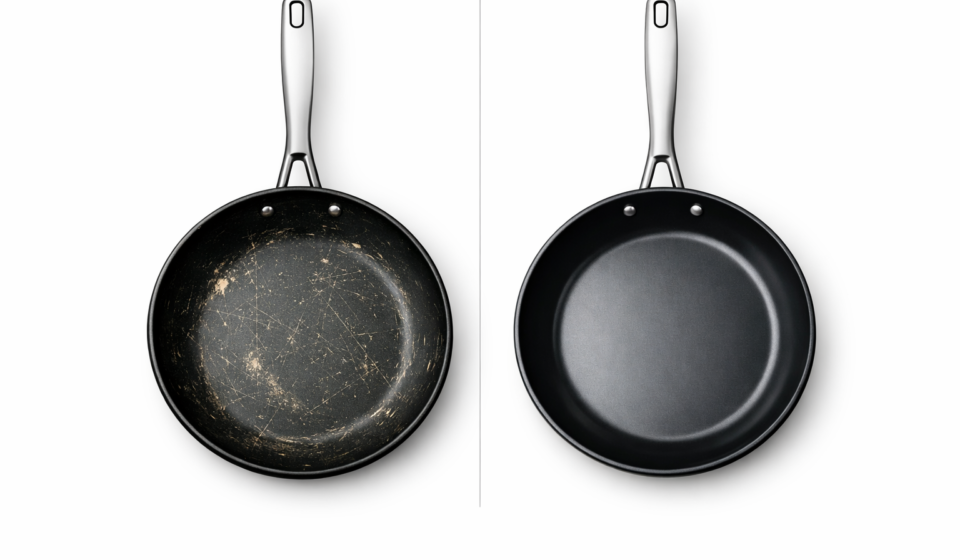
Inspect your pan under a bright light. Do you see deep gouges from an accidental swipe of a metal fork? Are there tiny, dark pits where the shiny coating has worn away to reveal the dull gray aluminum underneath? Is the surface actively peeling or flaking along the rim?
If a traditional PTFE pan is scratched to the point of peeling or flaking, you should retire it immediately. While ingesting small flecks of baked PTFE is generally considered chemically inert as it passes through the human digestive tract, a peeling coating means you are constantly eating degraded plastic particles. More importantly, those open scratches expose the raw, industrial-grade aluminum underneath, which can leach into highly acidic foods like tomato sauces or lemon reductions.
Sign 2: Dark, Permanent Discoloration
It is normal for a non-stick pan to darken slightly over months of use. However, if the center of your pan has turned a deep amber, dark brown, or patchy matte black, the polymer structure has fundamentally changed.
This deep discoloration is clear evidence that the pan has been severely overheated past its engineered thermal threshold. At this stage, the chemical bonds responsible for the “easy-release” behavior have been burned away, and the surface will transition from non-stick to highly adhesive.
Sign 3: The Sticky Food Test
The most obvious sign of a worn-out pan is behavioral. If you add a tablespoon of butter or oil to the pan and a standard grade-A egg still clings stubbornly to the center, requires heavy spatula scraping to flip, and leaves behind a torn, messy residue, the pan’s lifecycle is over. A non-stick pan that requires aggressive fat saturation and heavy scrubbing to clean defeats the entire operational purpose of owning non-stick cookware.
Sign 4: A Warped or Unstable Base
Sometimes the coating survives, but the physical chassis of the pan fails. If you place your empty skillet down on a perfectly flat glass-top electric or induction stove and it wobbles, spins, or bows upward in the center, the pan has warped.
Warping occurs when a pan is subjected to rapid temperature changes (thermal shock), causing the metal to unevenly expand and warp out of true. A warped pan cannot make uniform contact with a flat burner, leading to uneven heat distribution, cold zones, and ruined meals.
      STABLE FLAT BASE                     WARPED BOWED BASE

   ====================                 =========  =========
                                                 \  /
   --------------------                 --------------------
    [ Full Contact ]                     [ Uneven Heat Zones ]
The Hidden Threat to Household Pets: PTFE Off-Gassing
For households that keep domestic pet birds (such as parrots, canaries, budgies, or cockatiels), monitoring the age and condition of traditional non-stick cookware is a matter of literal life and death.
As traditional PTFE non-stick coatings age, scratch, and degrade, their structural thermal ceiling drops significantly. While a brand-new, pristine PTFE pan can safely withstand heat up to 500°F (260°C), a heavily worn, micro-fractured pan can begin to undergo thermal pyrolysis at lower temperatures. This process releases invisible, odorless fluorinated particulates and gases into your home’s air supply.
Because birds possess an incredibly advanced, hyper-efficient respiratory loop utilizing specialized air sacs to maximize oxygen absorption, they absorb airborne toxins instantly. Exposure to trace amounts of degraded PTFE fumes triggers an acute medical emergency known as PTFE toxicosis.
The bird’s lungs instantly fill with fluid and hemorrhage, leading to sudden asphyxiation. If you notice your non-stick pans are starting to show their age and you have avian pets in the home, do not risk an accidental overheat—replace them immediately, or make a permanent switch to mineral-based ceramic or stainless steel.
5 Habits to Maximize the Lifespan of Your Non-Stick Cookware
While non-stick pans will never last forever, practicing disciplined kitchen habits can easily double their lifespan, moving your replacement timeline from 1 year closer to the 5-year ceiling. Follow these five rules to protect your investment:
1. Banish Metal Utensils Completely
The quickest way to destroy a brand-new non-stick coating is to use metal spoons, whisks, tongs, or spatulas. Even if a manufacturer claims their coating is “metal-utensil safe due to diamond infusion,” basic physics dictates that steel will always scratch plastic or glass glazes. Treat your non-stick surface with gentleness: use exclusively high-heat silicone, nylon, or natural wood utensils.
2. Stop Preheating a Dry Pan
Never place an empty non-stick pan over an active burner and walk away to chop ingredients. Because aluminum is a highly conductive metal heat-sink, an empty pan can skyrocket past the 500°F danger zone in under two minutes on a standard gas or induction stove. Always place a thermal buffer—such as a teaspoon of cooking oil, a pat of butter, or the food itself—into a cold pan before you turn on the dial. The food will absorb the initial wave of energy, protecting the underlying coating.
3. Keep the Heat Dial on Low to Medium
Non-stick cookware was never engineered for high-heat tasks like searing steaks, stir-frying veggies, or blackening fish. Those jobs belong to cast iron or multi-ply stainless steel. Reserve your non-stick pans exclusively for low-to-medium thermal tasks like scrambling eggs, cooking pancakes, simmering delicate dairy creams, or sweating onions. If your recipe requires you to turn your burner dial past the midway point, you are using the wrong pan.
+-----------------------------------------------------------------+
|                    THE RIGHT PAN FOR THE RIGHT JOB              |
+-----------------------------------------------------------------+
| LOW/MEDIUM HEAT (Eggs, Crepes, Fish)   ===> Use Non-Stick       |
| HIGH HEAT (Steaks, Stir-Firy, Searing) ===> Use Cast Iron/Steel |
+-----------------------------------------------------------------+
4. Say No to Aerosol Non-Stick Cooking Sprays
It seems counterintuitive, but commercial aerosol cooking sprays (like Pam) will permanently ruin a non-stick pan. These cans rely on chemical propellants and emulsifiers (most commonly soy lecithin) to force the oil out of the nozzle.
Under cooking heat, these chemical agents polymerize and form a sticky, clear, plastic-like varnish that bakes directly into the pores of the non-stick surface. This residue cannot be stripped away by dish soap, permanently destroying the pan’s release properties. Instead, invest in a simple, refillable manual oil mister pump, or use a pourable oil or whole butter.
5. Always Hand Wash (Skip the Dishwasher)
Even if a pan is explicitly labeled as “dishwasher safe,” never place it inside the appliance. Dishwasher environments are incredibly harsh: they combine aggressive, highly abrasive powder detergents with sustained, high-temperature water sprays and drying cycles. This combination accelerates the oxidation of the pan’s exposed metal base and rapidly strips away the slickness of the interior coating. Allow your pans to cool naturally, then wash them gently by hand using warm water, a mild liquid dish soap, and a soft yellow sponge.
Summary: The Cost of Doing Business in the Kitchen
Ultimately, you must view non-stick cookware as a consumable tool with a finite lifecycle. Unlike cast iron, which rewards you for decades of use by building up a deep patina, a non-stick pan is at its absolute best the very day you slide it out of its box, and it slowly degrades from that moment forward.
+-------------------------------------------------------------------------+
|                    THE NON-STICK REPLACEMENT BLUEPRINT                  |
+-------------------------------------------------------------------------+
|  THE REALITY:                                                           |
|  Expect a 2-to-5-year operational window under optimal conditions.      |
|                                                                         |
|  THE TRIGGER CRITERIA:                                                  |
|  Replace immediately if you observe:                                    |
|    • Deep scratches revealing raw aluminum core                         |
|    • Flaking/peeling surface elements                                    |
|    • Dark burn-discoloration paired with sticky performance             |
+-------------------------------------------------------------------------+
By recognizing the signs of terminal wear and adhering to smart maintenance habits—like keeping temperatures down, washing by hand, and using silicone tools—you can ensure your non-stick pans remain safe, effective, and highly rewarding to cook with until it is time for their next scheduled upgrade!