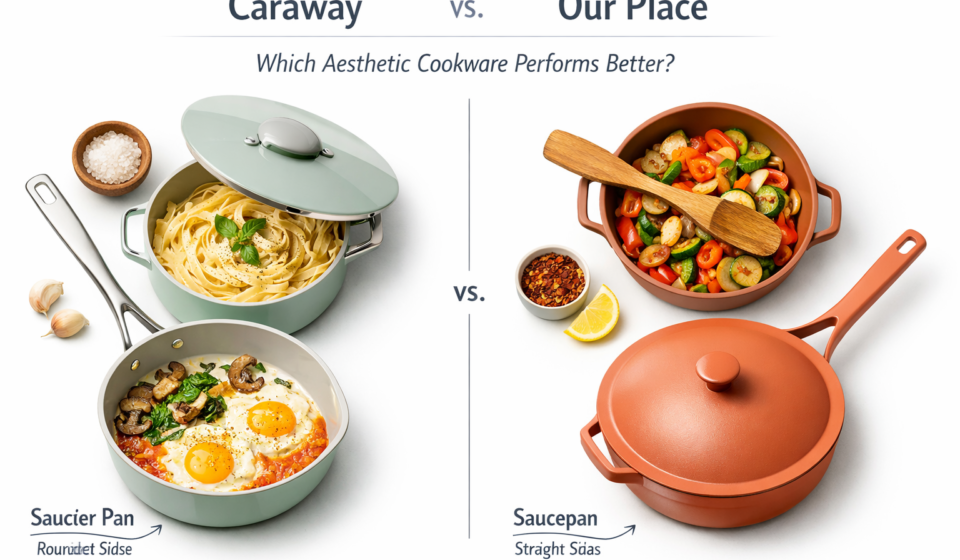

Caraway vs. Our Place: Which Aesthetic Cookware Performs Better?
The landscape of home cooking experienced a massive shift in the late 2010s and early 2020s. For decades, choosing cookware meant deciding between industrial, heavy-duty stainless steel, rugged black cast iron, or utilitarian, dark-gray Teflon pans. Cookware was designed to be hidden away in dark cabinets, pulled out only for active meal prep, and scrubbed out of sight.
Then came the “aesthetic cookware” revolution. Driven by social media platforms, minimalist interior design trends, and a generation of home cooks operating in compact apartment kitchens, cookware transformed from a hidden utility into a centerpiece of kitchen decor. Suddenly, pans were expected to do more than just sear a chicken breast; they were required to look stunning sitting on a matching linen towel, match the color palette of a modern kitchen backsplash, and transition effortlessly from the stovetop to an Instagram feed.
Two brands rose to absolute dominance in this design-forward market: Caraway Home and Our Place.
Both brands targeted the exact same demographic: design-conscious home cooks who wanted eco-friendly, non-toxic, beautifully colored cookware that simplified the cooking process. Both brands heavily marketed their proprietary ceramic non-stick coatings, free of traditional chemicals like PTFE, PFOA, and heavy metals.
However, beneath their gorgeous matte finishes and gold-accented hardware, Caraway and Our Place approach kitchen utility from completely opposite philosophies. Caraway embraces the traditional “Set-Based” philosophy, offering optimized, specialized pans for distinct cooking tasks. Our Place champions the “Multifunctional Minimalism” philosophy, engineering single, deeply specialized vessels designed to replace up to eight or ten traditional pieces of kitchen gear.
If you are looking to invest your hard-earned money into a premium, picture-perfect kitchen setup, you shouldn’t just buy based on color swatches. You need to know how these materials hold up to high heat, how they distribute thermal energy, and which brand actually performs better when the cameras are turned off.
This comprehensive, deep-dive comparison will break down Caraway and Our Place across every critical metric: materials, non-stick performance, ergonomics, durability, and long-term value.
The Contenders: Brand Overviews and Philosophies
Before diving into the technical performance testing, it is crucial to understand what each brand is trying to achieve with its product design.
Caraway Home: The Organized Classicist
Launched in 2019, Caraway entered the market with a beautifully packaged, 4-piece ceramic-coated aluminum cookware set. Caraway’s core thesis is built around streamlined organization and traditional cooking utility. They don’t want to change how you cook; they want to change how you store and maintain your kitchen.
Every full Caraway set ships with custom-molded magnetic pan racks and a canvas lid organizer that hangs inside a cabinet door. The aesthetic is clean, streamlined, mid-century modern, featuring industrial-leaning stainless steel handles and a vast array of sophisticated gloss and matte colorways ranging from “Cream” and “Sage” to limited-edition metallic finishes.
Our Place: The Multifunctional Innovator
Co-founded by Shiza Shahid in 2019, Our Place took the internet by storm with a single, viral product: The Always Pan. Rather than convincing users to buy a massive set, Our Place argued that the modern cook only needs one or two highly engineered pieces of gear.
The Always Pan was marketed as an “8-in-1” (and later upgraded to a “10-in-1” with the Always Pan 2.0) kitchen miracle that functions as a skillet, sauté pan, steamer, saucier, fry pan, spatula rest, and non-stick vessel. The Our Place aesthetic is distinctly earthy, soft, and textured. The pans feature a matte, sand-blasted exterior finish, modular wooden accessories, and a signature chunky, squared-off handle system.
1. Material Construction and Heat Performance
A pan’s performance lives and dies by its core material composition. The thickness and type of metal used dictate how fast a pan heats up, how evenly it distributes that heat, and how well it maintains its temperature when cold food is added.
+-----------------------------------------------------------------------+
|                       CONSTRUCTION COMPARISON MATRIX                  |
+-----------------------------------------------------------------------+
| FEATURE               | CARAWAY HOME            | OUR PLACE (2.0)     |
+-----------------------+-------------------------+---------------------+
| Base Material         | Heavy-Gauge Aluminum    | Cast Aluminum       |
| Induction Plate       | Integrated Steel Disc   | Integrated Steel    |
| Interior Coating      | Sol-Gel Ceramic         | Thermolon Ceramic   |
| Weight (Standard Pan) | 2.8 lbs (Fry Pan)       | 3.0 lbs (Always Pan)|
| Oven Safe Temp        | Up to 550°F             | Up to 450°F         |
+-----------------------+-------------------------+---------------------+
Caraway Heat Performance
Caraway pans are constructed from a heavy-gauge aluminum core that is impact-bonded with a magnetic stainless steel base plate. This construction approach is highly effective. The thick aluminum body acts as an exceptional thermal conductor, drawing energy from the stovetop and radiating it evenly up the sidewalls of the pan.
During thermal testing, Caraway pans show excellent heat distribution. When placed over an induction or gas element, the pan develops minimal hot spots. Water boils uniformly across the entire floor of the pan, and when searing proteins, you get consistent browning whether the food is sitting directly in the center or pushed to the outer perimeter. Furthermore, because the walls are thick, the pan retains thermal energy well, meaning the pan’s temperature doesn’t instantly tank when you drop a cold, raw steak onto the surface.
Our Place Heat Performance
The Always Pan 2.0 is constructed from ultra-durable, post-consumer recycled cast aluminum. Cast aluminum behaves slightly differently than the rolled aluminum used by Caraway. It heats up incredibly fast—almost instantaneously—making it phenomenal for rapid weeknight meals, boiling quick sauces, or frying a fast egg.
However, because the Always Pan features unique structural geometry—high, sloping walls designed to mimic a cross between a wok, a skillet, and a saucepan—the heat distribution can be uneven depending on your heat source. On standard gas ranges, the heat tends to concentrate heavily at the base floor of the pan, while the tall sidewalls stay noticeably cooler. If you are trying to cook a large volume of food that fills the pan, you will need to stir frequently to ensure everything cooks at the same rate.
Winner: Caraway.
Caraway’s traditional proportions and uniform thickness provide superior heat retention and a more balanced, predictable cooking surface across various cooktop styles.
2. Non-Stick Slickness and Chemical Safety
Both brands heavily emphasize their clean-cooking credentials. They utilize a type of ceramic coating known as Sol-Gel. This coating is made from an inorganic silicon dioxide (sand) compound that is applied to the interior of the pan and baked to create a glossy, glass-like finish. It is naturally slick without requiring PTFE (Teflon), meaning it won’t release toxic fumes if accidentally overheated.
The Caraway “Mirror” Finish
Caraway uses a highly polished, incredibly smooth ceramic coating. Out of the box, the slickness of a Caraway pan is astonishing. Eggs slide around without a single drop of oil, and sticky residues like burned cheese or teriyaki glaze lift away with a gentle wipe of a paper towel.
Because Caraway sells specialized pans, their Fry Pan features low, flared walls that allow steam to escape efficiently. This shape, combined with the slick interior, makes it an absolute joy for flipping delicate foods like crepes, omelets, and fish fillets.
The Our Place “Textured” Finish
The Always Pan 2.0 features a proprietary ceramic coating that feels slightly more textured to the touch than Caraway’s slick finish. While it is still immensely non-stick compared to raw stainless steel, it exhibits a higher coefficient of friction out of the box than Caraway.
You will generally need to use a small half-teaspoon of butter or oil to get eggs to slide with absolute freedom. Where Our Place shines, however, is with saucy dishes. Because the Always Pan features high 3-inch walls, it excels at handling shallow pan-frying, simmering curries, or tossing pasta with thick sauces without spilling over the edges.
Winner: Caraway (for raw slipperiness); Our Place (for volume management).
If your primary metric for non-stick performance is the classic “egg slide test,” Caraway wins. If you measure non-stick convenience by the ability to stir-fry and simmer large volumes of food without making a mess, Our Place takes the crown.
3. Ergonomics, Utility, and Multifunctionality
This is where the philosophical divergence between the two brands becomes visually and physically apparent. How a pan feels in your hand and how it adapts to your cooking workflow dictates whether you will love using it every day or leave it to gather dust.
The Always Pan’s Multi-Tool Brilliance
It is impossible to discuss Our Place without praising the sheer engineering intellect of the Always Pan’s design. It genuinely delivers on its promise to clear out cluttered kitchen cabinets.
-
The Steamer Basket: Every Always Pan ships with a custom-fitted, nestable stainless steel steamer basket. You can boil pasta or steam broccoli, lift the basket out, and immediately use the water below for another task.
-
The Spatula Nest: The pan handle features a integrated metal peg that matches a custom slot cut into the included beechwood spatula. This allows your spatula to hover directly over the pan when not in use, catching drips and eliminating the need for a separate spoon rest on your countertop.
-
The Pour Spouts: The pan features two built-in pouring spouts on either side of the rim. When combined with the modular lid, you can turn the lid to completely seal in steam, or rotate it slightly to open up the spouts for easy straining of pasta water.
However, this multifunctionality comes with an ergonomic compromise. The main handle of the Always Pan is a thick, hollow square cast aluminum block. It can feel bulky and difficult to grip securely if you have smaller hands, especially when the pan is filled to capacity with a heavy stew.
+-----------------------------------------------------------------+
|                   PHILOSOPHICAL DESIGN BLUEPRINT                |
+-----------------------------------------------------------------+
| CARAWAY HOME:                                                   |
|   [Fry Pan]   [Sauté Pan]   [Sauce Pan]   [Dutch Oven]          |
|       |            |             |             |                |
|       +------------+-------------+-------------+                |
|                    |                                            |
|                    v                                            |
|       (Optimized Task Performance & Cabinet Storage)            |
|                                                                 |
| OUR PLACE:                                                      |
|   [================= ALWAYS PAN 2.0 =================]          |
|   (Skillet + Sauté + Steamer + Saucier + Fryer + Spoon Rest)    |
+-----------------------------------------------------------------+
Caraway’s Seamless Flow
Caraway rejects the multi-tool approach in favor of traditional, fine-tuned culinary ergonomics. Their handles are made of solid, polished stainless steel that is cast into a sleek, rounded rectangular shape. It features a clever, raised indentation on the underside (a “heat stop”) that alerts your finger before it slides too close to the hot base of the pan.
Caraway pans feel exceptionally balanced in the hand. When you lift the 10.5-inch fry pan, the weight distribution sits comfortably back toward your wrist, allowing for effortless wrist-flipping and maneuvering. Furthermore, because Caraway provides a full 4-piece set, you never have to make compromises. You don’t have to boil your marinara sauce in the same pan you just used to sear salmon; you simply pull the dedicated saucepan or Dutch oven from its beautifully organized magnetic rack.
Winner: Our Place.
When it comes to pure utility innovation, Our Place changed the game. The sheer convenience of the built-in spoon rest, integrated steamer, and dual pour spouts makes it a masterpiece of compact kitchen engineering.
4. The Critical Weakness: Longevity and Durability
We must address the elephant in the kitchen regarding all ceramic non-stick cookware, regardless of the brand: ceramic coatings do not last forever.
Unlike traditional Teflon, which can peel or flake but retains its slipperiness for a few years, or cast iron, which gets better with age, ceramic coatings degrade over time due to microscopic thermal fracturing and oil carbonization. Eventually, all ceramic pans lose their non-stick properties.
Therefore, durability testing boils down to which pan preserves its slickness the longest under normal household wear and tear.
Caraway’s Durability Outlook
Because Caraway utilizes a smooth, glass-like gloss coating, it is highly sensitive to thermal abuse and improper cleaning. If you use aerosol cooking sprays (which contain chemical propellants that bake into the ceramic pores) or blast the pan on “High” heat constantly, a Caraway pan can begin to lose its non-stick properties within 6 to 9 months.
However, if you strictly follow the maintenance rules—cooking on low-to-medium heat, using a splash of real butter or oil, and exclusively hand-washing with a soft sponge—Caraway pans can easily maintain their exceptional performance for 2 to 3 years. One vulnerability to note is the gorgeous exterior paint finish: because it is glossy, it can chip or develop dark carbon scuff marks if it is repeatedly dragged across rough iron gas grates.
Our Place’s Durability Evolution
The original Always Pan 1.0 was plagued by online reviews complaining that the non-stick coating failed within a matter of months. Our Place listened to this feedback and completely re-engineered their manufacturing process for the Always Pan 2.0.
The 2.0 version features a proprietary coating called “Thermolon Ultra,” which is infused with microscopic industrial diamonds to enhance structural hardness. This upgrade significantly improved the pan’s lifespan. The exterior sand-blasted matte finish is also remarkably resilient against gas stovetop scratches compared to Caraway’s high-gloss shells.
However, because the Always Pan is designed to be used for everything (frying, boiling, steaming, braising), it accumulates wear-and-tear cycles at three times the speed of an individual pan in a Caraway set. If you use your Always Pan three times a day for every single meal, the central cooking zone will inevitably experience coating degradation faster than a distributed set of pans.
Winner: Tie.
Caraway’s coating starts out slicker, but its exterior paint is prone to cosmetic scuffing on gas ranges. Our Place 2.0 has a tougher exterior matte finish and a hardened coating, but because the single pan bears the brunt of all your daily cooking tasks, it accumulates wear rapidly.
5. Stovetop-to-Oven Versatility
A crucial component of advanced home cooking is the ability to sear a protein on the stovetop and transfer the entire pan into the oven to finish cooking through (essential for thick chicken breasts, pork chops, or frittatas).
-
Caraway’s Oven Performance: Caraway cookware is an absolute beast in the oven. Because the handles are solid stainless steel and the ceramic compound is highly stable, every single pan in the Caraway collection is oven-safe up to 550°F. This puts it on par with professional-grade stainless steel and allows you to use the Dutch oven for baking artisanal sourdough bread at extreme temperatures.
-
Our Place’s Oven Performance: The Always Pan 1.0 was completely incompatible with the oven due to its wooden accessories and plastic component styling. The Always Pan 2.0 corrected this by making the body oven-safe up to 450°F. While this is perfectly adequate for most standard roasting and baking tasks, you cannot use it under a high-heat broiler, and you must remember to remove the wooden spatula before putting the pan into the oven.
Winner: Caraway.
With a 100°F higher heat threshold and no accessory restrictions, Caraway is the vastly superior choice for complex, multi-stage oven recipes.
Final Verdict: Which Brand Belongs in Your Kitchen?
Choosing between Caraway and Our Place ultimately comes down to an honest assessment of your personal cooking style, your kitchen storage capacity, and how many people you cook for on a regular basis.
+-----------------------------------------------------------------+
|                    THE DECISION ARCHITECT                       |
+-----------------------------------------------------------------+
| BUY CARAWAY IF:                                                 |
|   • You cook multi-course meals simultaneously.                 |
|   • You want premium oven-to-stovetop versatility (up to 550°F). |
|   • You have dedicated cabinet space and love pristine storage.  |
|                                                                 |
| BUY OUR PLACE IF:                                               |
|   • You live in a small apartment or tiny home with zero space. |
|   • You typically cook single-pot, quick weeknight meals.       |
|   • You love intelligent, built-in accessories like spoon rests.|
+-----------------------------------------------------------------+
Choose Caraway Home if…
You consider yourself an active, enthusiastic home cook who regularly prepares multi-course meals, hosts dinner parties, or cooks for a family of three or more. If you need to simmer a sauce, boil pasta, and sear a protein all at the same time, you need a set of specialized tools.
Caraway provides an uncompromising, professionally balanced cooking experience wrapped in a stunning modern design. Its superior heat retention, higher oven safety thresholds, and included modular magnetic storage system make it a true upgrade for a fully functional kitchen.
Choose Our Place if…
You live in a compact studio apartment, a tiny home, or a dorm room with severely limited cabinet storage space. If you are a minimalist who typically cooks single-portion meals, quick stir-fries, or simple weeknight pasta dishes for one or two people, the Always Pan 2.0 is a triumph of lifestyle engineering.
It eliminates visual clutter, looks incredibly chic sitting permanently on top of your stove, and handles an impressive array of culinary techniques without forcing you to buy, wash, and store a half-dozen separate metal pots and pans.
Both brands have successfully proven that kitchenware can be both highly functional and deeply beautiful. Assess your space, choose your colorway, and enjoy the slick, non-toxic benefits of modern ceramic cooking!