
Affiliate disclosure: Modern Kitchen Cookware participates in the eBay Partner Network. We may earn a commission from qualifying purchases through our affiliate links, at no extra cost to you.
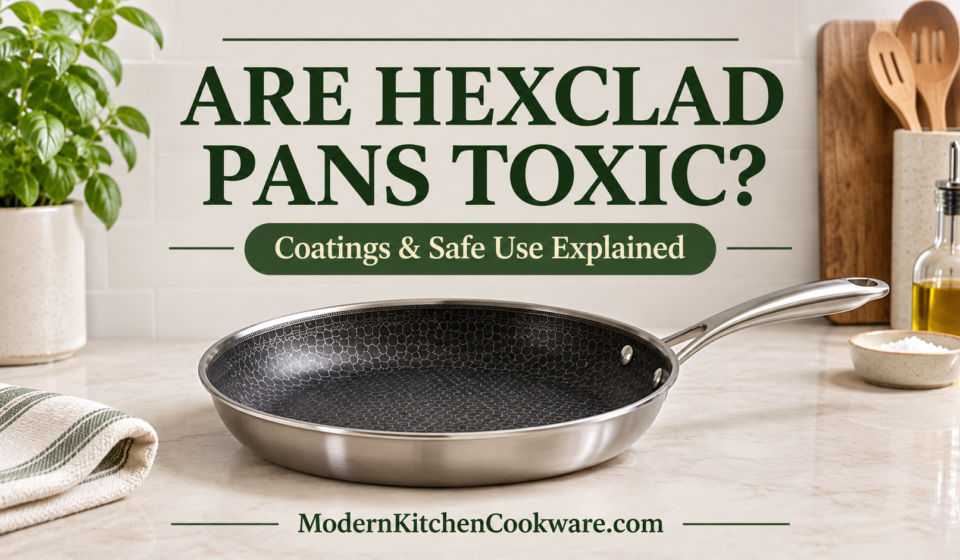
Are HexClad pans toxic? The brand name alone cannot answer that question. You need to identify the exact pan, its coating, its condition, and how it is used. HexClad currently describes its TerraBond ceramic coating as PTFE-free and PFAS-free; that is a manufacturer claim about the current coating, not a personal safety assessment of every pan sold under the brand.
A better starting point than a blanket “toxic” or “non-toxic” label is a specific question: Which material am I trying to avoid, and what evidence identifies the surface of this particular pan?
Editorial note: This article summarizes public manufacturer and government information. We have not laboratory-tested HexClad cookware. It does not diagnose exposure or replace advice from a qualified health professional about an individual medical concern.
Start by identifying the coating
HexClad’s current FAQ identifies TerraBond as its ceramic nonstick coating and states that it is free of PTFE and PFAS. Check the product page, packaging, and instructions for the item you own or plan to buy. Do not infer its composition solely from a hexagonal pattern or a seller’s short description.
Older reviews, old packaging, and current manufacturer pages may describe different products. A current FAQ does not establish the composition of an unidentified secondhand pan. If those sources conflict, contact the manufacturer with photographs and model information rather than guessing from the purchase year.
This is particularly relevant for eBay purchases: “new” describes the seller’s stated condition, not necessarily a current production generation. Unused older stock may still require identification.
PFAS, PTFE, and PFOA are different terms
Health Canada describes PFAS as a broad class of substances, PTFE as a PFAS used in many nonstick coatings, and PFOA as a substance formerly used in producing nonstick coatings. Consequently, a PFOA-free claim does not, by itself, establish that a coating is PTFE-free or free of all PFAS.
| Label or term | What to ask next |
|---|---|
| PFOA-free | What other coating materials are present? |
| PTFE-free | What is the replacement coating, and what evidence supports the claim? |
| PFAS-free | Does this claim apply to this exact product and generation? |
| Non-toxic | Which substances, tests, and conditions does the claim address? |
Do not treat a brand’s broad marketing language as a substitute for specific material information. Equally, the presence of an unfamiliar chemical name does not by itself establish that normal use causes harm.
What does the FDA say about nonstick coatings?
The FDA explains that authorized nonstick cookware applications use polymerized PFAS coatings bound to the cookware during manufacturing. Its description says this process produces a coating with a negligible amount capable of migrating to food.
That is general information about authorized food-contact applications. It does not certify a particular HexClad model, verify an unknown marketplace item, or establish safety under every condition. It also does not mean every substance in the wider PFAS family has the same properties.
Temperature limits are not routine cooking targets
Health Canada advises against empty preheating and high-heat use of nonstick cookware, and recommends ventilation. Always consult the instructions for your exact coating and observe the more restrictive applicable limit for the cooking task.
A prominently advertised oven rating should not be read as an instruction to leave an empty coated pan over a burner. Burner settings, an oven’s air temperature, and the temperature of a dry pan surface are different things. Lids and accessories may also have different limits.
If you cannot identify an older pan’s coating or instructions, ask the manufacturer before relying on the specifications of its current replacement.
What if the surface is peeling, damaged, or behaving unusually?
Stop using a pan with peeling or flaking coating until the manufacturer has assessed it or you have replaced it. Photograph the surface and describe what happened. Do not try to sand off an unidentified coating or repair it with a household coating product.
If smoke develops, stop heating and ventilate when safe to do so. Seek appropriate medical or poison-control advice if someone develops symptoms or you suspect an exposure. A cookware buying guide cannot determine what caused a symptom.
Does stainless steel remove every cookware concern?
Uncoated stainless steel avoids the question of a nonstick surface coating, but that does not make it a universal medical recommendation. Material suitability, food, cooking conditions, and individual sensitivities can still matter.
For a practical comparison of coated and uncoated options, see our ceramic vs stainless steel cookware guide. If you prefer an uncoated alternative, our HexClad vs All-Clad article focuses on All-Clad’s uncoated D3 line.
A checklist for buyers and existing owners
- Identify the model and coating from reliable product information.
- Check whether the information describes current production or your specific older item.
- Read the care instructions, including heat and utensil guidance.
- Inspect the surface and ask about any damage or unusual wear.
- Keep packaging, receipts, and the manufacturer’s reply for reference.
Do not buy an unclear listing merely because it carries an attractive discount. Ask the seller for the information you need. If a specific material is unacceptable to you and cannot be verified, choose a clearly documented alternative.
Frequently asked questions
Does current HexClad cookware contain PTFE?
HexClad says its current TerraBond coating is PTFE-free and PFAS-free. Confirm that the exact item offered uses that coating; do not apply the statement automatically to unidentified older stock.
Is ceramic coating the same as an uncoated pan?
No. A ceramic nonstick surface is still a coating. If your goal is to avoid nonstick coatings altogether, compare uncoated cookware.
Should I throw away my pan because I read a frightening review?
First identify the actual product and assess its condition and instructions. A review of another generation is not enough to establish the condition or risk of your pan. Stop using damaged cookware while seeking product-specific guidance.
Our conclusion
There is no useful brand-wide yes-or-no verdict without identifying the cookware. Verify current claims, resolve uncertainty about older pans, and use the right instructions. Once you have addressed the coating question, our Is HexClad Worth It? guide can help you decide whether its price and design fit your kitchen.
If you decide to replace a pan, you can browse cookware options in our Shop. A seller listing is not evidence of a product’s composition or safety; verify the exact model first.
Sources