
Dutch Ovens: Le Creuset vs. Staub vs. Lodge—The Ultimate Comparison
If you could only own a single piece of cookware for the rest of your life, the smart choice would be an enameled cast iron Dutch oven.
Often called the absolute workhorse of the kitchen, a premium Dutch oven can handle an astonishingly wide array of culinary tasks. It can braise tough cuts of meat down into fork-tender pot roasts, simmer complex stocks for hours without boiling over, deep-fry chicken with exceptional temperature stability, and bake artisanal, sourdough bread with a shatteringly crisp crust that rivals a professional bakery.
Because a Dutch oven is built from thick, heavy cast iron coated in vitreous glass enamel, it is fundamentally designed to last for generations. It is an investment piece, an heirloom that you will pass down to your children.
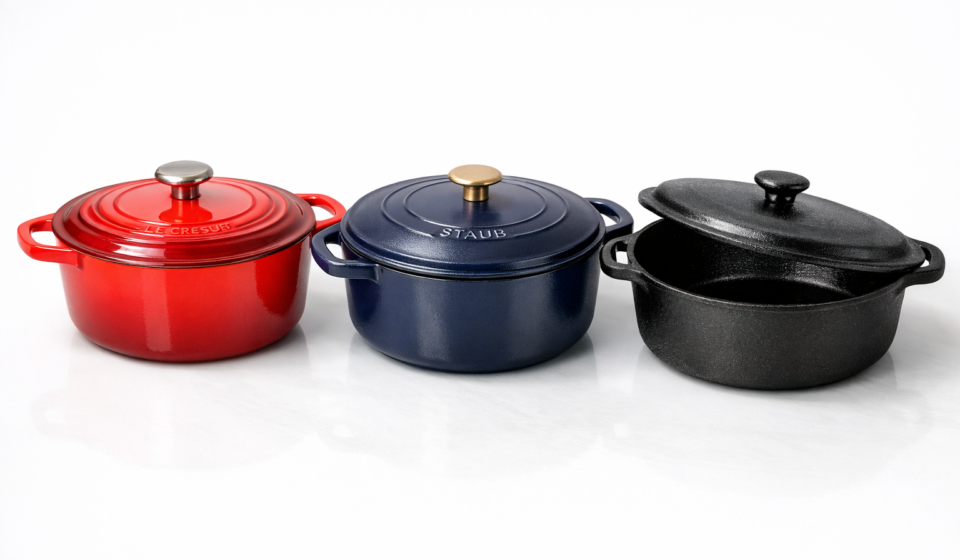
But when you open up a browser to buy one, you are immediately confronted with three titanic brands that dominate the market: Le Creuset, Staub, and Lodge.
The price gaps between them are jarring. A standard 5.5-quart Le Creuset or Staub will easily set you back between $350 and $450. Meanwhile, you can pick up a similarly sized Lodge Dutch oven at a local hardware store or online for around $50 to $80.
Are the European luxury brands worth the extra hundreds of dollars, or are you simply paying for a fancy stamp on the bottom of the iron? Does a black matte interior perform better than a cream-colored enamel?
This comprehensive, 2000-word deep-dive comparison will tear down Le Creuset, Staub, and Lodge across every critical metric—material engineering, thermal performance, interior design, ergonomics, and long-term durability—to determine which Dutch oven truly deserves a permanent home on your stovetop.
The Contenders: Brand Profiles and Philosophies
To understand why these three pans are engineered so differently, it helps to look at where they come from and who they are built for.
+-----------------------------------------------------------------------+
|                        QUICK SPECIFICATIONS MATRIX                     |
+-----------------------------------------------------------------------+
| METRIC                | LE CREUSET (ROUND)      | STAUB (COCOTTE)     | LODGE (ROUND)       |
+-----------------------+-------------------------+---------------------+---------------------+
| Origin                | France (Fresnoy-le-Grand| France (Alsace)     | China (Designed USA)|
| Standard Size Tested  | 5.5 Quart               | 5.5 Quart (Cocotte) | 6.0 Quart           |
| Interior Enamel       | Glossy Cream            | Textured Matte Black| Glossy Cream        |
| Lid Underside         | Smooth, Slightly Domed  | Flat with Spiked Chix| Smooth, Domed       |
| Weight (With Lid)     | 11.4 lbs                | 12.5 lbs            | 13.5 lbs            |
| Price Segment         | Ultra-Premium Luxury    | Ultra-Premium Luxury| High-Value Budget   |
+-----------------------+-------------------------+---------------------+---------------------+
1. Le Creuset: The Icon of Colorful Luxury
Founded in 1925 in Fresnoy-le-Grand, France, Le Creuset pioneered the process of coating raw cast iron in bright, porcelain enamel. Their signature color, “Volcanic Flame” (a brilliant, glowing orange), was inspired by the fiery molten iron inside their foundry cauldrons.
Le Creuset approaches Dutch oven design through the lens of timeless elegance and maximum usability. Their vessels are famous for having the thinnest, lightest iron casting in the premium category, making them easier to lift and handle. They champion bright, high-gloss gradient colorways and smooth, cream-colored interiors.
2. Staub: The Professional Chef’s Choice
Hailing from the Alsace region of France—a culinary hotbed famous for rich, slow-simmered stews—Staub was founded in 1974 by Francis Staub. If Le Creuset is a beautifully tailored silk suit, Staub is an armored tank.
Staub approaches cookware through a lens of professional-grade culinary mechanics. Their lids are completely flat and heavy, engineered to seal moisture in with mathematical precision. Instead of a shiny, smooth interior, Staub utilizes a dark, textured matte black enamel that is highly praised by professional chefs for its intense searing capabilities.
3. Lodge: The Democratic Everyday Hero
Lodge is the oldest continuously operating cookware manufacturer in America, founding its foundry in South Pittsburg, Tennessee, back in 1896. While Lodge is famous worldwide for its raw, un-enameled black cast iron, they introduced an affordable enameled line to make Dutch oven cooking accessible to the masses.
To keep the price point accessible, Lodge designs their enameled cookware in the United States but manufactures the line in China. Lodge rejects the luxury pretension of the French brands, offering a thick, heavy, straightforward pot that delivers the raw power of cast iron cooking at a fraction of the cost.
1. Material Engineering: Weight, Geometry, and Thermal Performance
A Dutch oven works by utilizing its immense mass to absorb heat slowly and radiate it back into the food from all directions simultaneously, turning the pot into a mini-oven right on top of your stove. However, the exact thickness and balance of the iron vary wildly between these three brands.
Le Creuset: The Mastery of Casting
The gold standard of cast iron manufacturing is creating a pot that is incredibly strong but as thin and light as possible. This requires flawless, purer iron alloys and pristine sand molds. Le Creuset is the absolute master of this craft.
A 5.5-quart Le Creuset weighs 11.4 pounds with the lid on. The walls are perfectly uniform in thickness, which completely eliminates the risk of localized hot spots. On the stove, Le Creuset heats up smoothly and predictably. When moved into a conventional oven, its uniform thickness ensures that food bubbling inside cooks at the exact same speed at the top of the pot as it does at the bottom.
Staub: The Heavyweight Retainer
Staub takes the opposite approach. A 5.5-quart Staub Cocotte tips the scales at 12.5 pounds—a full pound heavier than Le Creuset. The iron walls are thicker, and the lid is massive and dense.
This extra weight gives Staub an edge in pure heat retention. When you drop a massive, cold, 4-pound chuck roast into a Staub to sear, the metal barely registers the temperature drop. The thick base holds onto thermal energy like a sponge, delivering an incredibly aggressive, hard sear that locks in deep caramelized flavors. The downside, of course, is that a fully loaded Staub can be punishingly heavy to lift out of a low oven.
Lodge: The Industrial Bruiser
Lodge’s 6-quart enameled oven is a beast, weighing in at a whopping 13.5 pounds. Because the casting process used in their overseas factories is less technically refined than the high-end French foundries, Lodge makes up for it by simply using more raw metal. The walls are thick, chunky, and heavy.
In testing, Lodge performs admirably. It takes slightly longer to preheat than Le Creuset, but once it reaches temperature, its thermal mass is undeniable. It holds heat beautifully for deep-frying and maintains a steady, low simmer perfectly. However, because the iron alloy is less refined, it is more vulnerable to micro-thermal fractures if exposed to rapid, extreme temperature changes.
Winner: Le Creuset.
Le Creuset achieves the perfect mathematical balance between incredible heat retention and manageable weight. It delivers premium thermal performance without requiring a gym membership to lift the pot.
2. Interior Enamel Philosophy: Cream Gloss vs. Black Matte
The interior coating of a Dutch oven is not just a cosmetic choice; it completely alters how you track your cooking progress and how you develop flavor.
+-----------------------------------------------------------------+
|                  THE INTERIOR SURFACE TRADEOFF                  |
+-----------------------------------------------------------------+
| GLOSSY CREAM ENAMEL (Le Creuset & Lodge)                        |
|  Pros: Incredible visibility; easily track fond and browning.   |
|  Cons: Shows dark stains, scratches, and discoloration over time.|
|                                                                 |
| TEXTURED MATTE BLACK ENAMEL (Staub)                             |
|  Pros: Superior high-heat searing; hides stains completely.    |
|  Cons: Difficult to see color changes in delicate sauces/butter.|
+-----------------------------------------------------------------+
The Case for Cream Enamel (Le Creuset & Lodge)
Both Le Creuset and Lodge feature a smooth, high-gloss, cream-colored vitrified glass interior. For the home cook, this design is an immense advantage for visibility.
When you are searing meat or sweating aromatics, the sugars and proteins form a sticky, golden-brown glaze on the bottom of the pot known as the fond. This fond is the foundational element of any great braise, soup, or pan sauce.
In a cream-lined pot, you can track the exact color of the fond with absolute precision. You can see the exact moment your butter transitions to a nutty brown, or when your onions move from translucent to caramelized. You know exactly when to deglaze with wine before the food burns.
The downside? Cream enamel shows its age. Over years of use, it will inevitably develop dark amber stains from highly acidic foods (like tomatoes), and metal utensils will leave gray scuff marks across the bottom.
The Case for Matte Black Enamel (Staub)
Staub stands completely alone by lining their pots with a dark, textured matte black enamel. This isn’t raw cast iron; it is a highly specialized glass enamel infused with microscopic quartz particles.
This textured surface creates a totally different cooking environment. The tiny peaks and valleys of the quartz aggregate act as thousands of tiny searing points. It grips fats beautifully and creates a superior, professional-grade crust on meats that cream enamel simply cannot replicate. Furthermore, because it is black, it never stains. Even after twenty years of cooking curries and red wine braises, a Staub interior looks exactly like the day you bought it.
The challenge with Staub is tracking browning. If you are making a delicate caramel or browning butter, it is nearly impossible to see the color change against the black backdrop. You have to rely on your sense of smell or use a spoon to scoop liquid onto a white plate to inspect it.
Winner: Tie.
Choose Le Creuset or Lodge if you prioritize visibility and precise browning control. Choose Staub if you prioritize a heavy, professional-grade sear and an interior that will never look stained or discolored.
3. Lid Mechanics and Moisture Control: The Battle Over Steam
The lid of a Dutch oven is its primary defense against evaporation. A poor-fitting lid lets steam escape, drying out your expensive meats during a long, 4-hour braise. Both French brands have invested immense engineering into how their lids handle moisture, while Lodge takes a simpler approach.
Staub’s Self-Basting Rain System
Staub’s lid is arguably their greatest engineering achievement. While Le Creuset and Lodge feature slightly domed lids that encourage condensation to run down the sides of the pot, Staub’s lid is completely flat, heavy, and fits with airtight precision.
On the underside of the Staub lid, you will find a matrix of dozens of tiny raised metal nodules called chistera spikes.
When you braise a dish, steam rises from the food, hits the hot lid, and condenses. In a standard domed pot, that moisture runs down the walls, washing back into the liquid.
On a Staub lid, the droplets form uniformly across the spikes. Once a droplet gets heavy enough, it falls directly straight down onto the food like rain. This creates a continuous, automated self-basting cycle that distributes moisture evenly across the entire surface of your meat, resulting in unparalleled juiciness.
+-----------------------------------------------------------------+
|                  THE LID CONDENSED WATER CYCLES                 |
+-----------------------------------------------------------------+
| LE CREUSET / LODGE DOMED LID:                                   |
|   Steam Rises -> Hits Dome -> Runs Down Walls Into Base          |
|                                                                 |
| STAUB FLAT SPIKED LID:                                          |
|   Steam Rises -> Condenses on Spikes -> Drops Directly Rain-Style|
+-----------------------------------------------------------------+
Le Creuset’s Tight Evaporation Barrier
Le Creuset’s lid features no spikes, but it is engineered with a continuous, heavy precision lip that creates a stable steam seal. It allows a minute amount of steam to escape safely through a specialized pressure rim to prevent the pot from rattling or boiling over violently, while retaining 99% of the liquid volume over hours of low-and-slow oven braising.
Lodge’s Standard Dome
Lodge features a standard, classic domed lid. While it is heavy enough to create an effective seal for general cooking, the manufacturing tolerances are noticeably looser than the French competitors.
If you inspect a Lodge lid closely, you may find small gaps or a slight wobble when it rests on the base. During an extended 3-to-4-hour braise, you will experience significantly more liquid evaporation in a Lodge, requiring you to check the pot periodically and add extra stock or wine to prevent the dish from running dry.
Winner: Staub.
The spiked, self-basting design of the Staub lid is a true marvel of culinary engineering, delivering unrivaled moisture distribution that keeps proteins incredibly moist.
4. Ergonomics: Handles and Knobs
When you are handling a blistering hot, 15-pound pot filled with boiling liquid, the shape of the handles ceases to be a minor aesthetic detail—it becomes a critical safety feature.
-
Le Creuset Signature Upgrades: In response to customer feedback, Le Creuset upgraded their line to include their “Signature” handles. These handles are 45% larger than traditional cookware handles, featuring a wide, open loop that allows you to easily slide four large fingers—fully enclosed in thick, bulky oven mitts—securely into the grip. Their standard knobs are made of solid, heat-safe composite or stainless steel that can withstand oven temperatures up to 500°F.
-
Staub’s Ergonomic Handles: Staub features sleek, elegant, but noticebly smaller rectangular loops. While they look incredibly stylish, they offer less clearance than Le Creuset. If you are wearing thick silicone oven mitts, it can be a tight squeeze to get a secure hold on the handles. However, Staub wins major points for their knobs: every Staub comes standard with a beautiful, heavy-duty nickel or brass metal knob that has no oven temperature restrictions whatsoever.
-
Lodge’s Teardrop Grip: Lodge utilizes small, rounded teardrop handles. Because the pot is the heaviest of the three, these smaller handles are the most difficult to manage safely. When moving a hot, full pot, your thumbs are often pressed tightly against the hot cast iron walls. Additionally, standard Lodge ovens ship with a plastic phenolic knob that is only oven-safe up to 400°F. If you want to bake artisan bread at 450°F or 500°F, you are required to purchase a separate stainless steel replacement knob from Lodge.
Winner: Le Creuset.
Le Creuset’s massive, oversized loop handles provide the safest, most secure grip in the industry when navigating a hot kitchen with oven mitts.
5. Value and Long-Term Durability: Is the Luxury Price Justified?
This is where the rubber meets the road for your wallet. Let’s look at the financial reality of buying these pots.
The French Luxury Investment (Le Creuset & Staub)
Paying $400 for a pot sounds astronomical to anyone who isn’t a professional chef. But here is the economic justification: you buy it once, and you never buy it again.
Both Le Creuset and Staub use proprietary, multi-layered enamel applications that are fused to the iron at over 1,400°F. This enamel is incredibly flexible and resilient against thermal shock. It resists chipping, cracking, and spiderweb fracturing even under decades of heavy daily use.
Furthermore, both French heritage brands offer an unconditional, rock-solid lifetime warranty. If the enamel on your Le Creuset or Staub chips or fails due to a manufacturing defect twenty years from now, they will replace the entire pot for free, no questions asked.
The Budget Reality (Lodge)
At around $70, the Lodge enameled Dutch oven is a phenomenal value proposition. It performs 85% as well as the French luxury pots at 20% of the cost. For a casual cook who only pulls out a Dutch oven four or five times a winter to make a batch of chili or pot roast, buying a Lodge is a no-brainer.
However, the lower price point shows up in long-term durability. Because the enamel application process used in overseas manufacturing is cheaper, the porcelain coating on a Lodge is significantly more brittle. It is highly prone to chipping along the rim where the lid contacts the base.
If you accidentally bang a metal spoon against the rim, or expose the pan to a sudden temperature shift, the enamel can crack or flake off entirely. Once the interior cooking enamel chips, the pot is no longer safe to use, as shards of glass enamel can migrate into your food. Lodge offers a limited lifetime warranty, but it is notoriously difficult to get replacements for chips caused by standard kitchen wear and tear.
Winner: Lodge (for immediate value); Le Creuset & Staub (for lifelong durability).
The Final Verdict: Which One Should You Buy?
To make your final decision simple, look at your budget, your cooking frequency, and your mechanical priorities:
+-----------------------------------------------------------------+
|                    THE DUTCH OVEN DECISION TREE                 |
+-----------------------------------------------------------------+
| BUY LE CREUSET IF:                                              |
|   • You want the lightest, most ergonomically balanced pot.     |
|   • You want a bright interior to easily monitor browning/fond. |
|   • You view cookware as a stunning heirloom investment.        |
|                                                                 |
| BUY STAUB IF:                                                   |
|   • You want the absolute best moisture retention and braising. |
|   • You prefer a stain-free, high-performance black interior.    |
|   • You love heavy-duty, professional restaurant-grade gear.     |
|                                                                 |
| BUY LODGE IF:                                                   |
|   • You want maximum performance on a tight budget.             |
|   • You only use a Dutch oven occasionally throughout the year. |
|   • You don't mind extra weight and more delicate enamel handling.|
+-----------------------------------------------------------------+
If you have the financial flexibility to view cookware as a lifelong investment, the ultimate victory goes to Le Creuset for general home cooks due to its lightweight ergonomics and stellar visibility. If you are a hardcore carnivore who prioritizes heavy meat braises and stews, Staub’s spiked lid and matte black quartz interior make it the culinary superior.
But if you simply want to cook delicious, comforting meals for your family without breaking the bank, Lodge delivers everything you need to get the job done beautifully. Pick the pot that matches your kitchen philosophy, and enjoy the magical, slow-simmered flavors that only a heavy cast iron Dutch oven can create!