
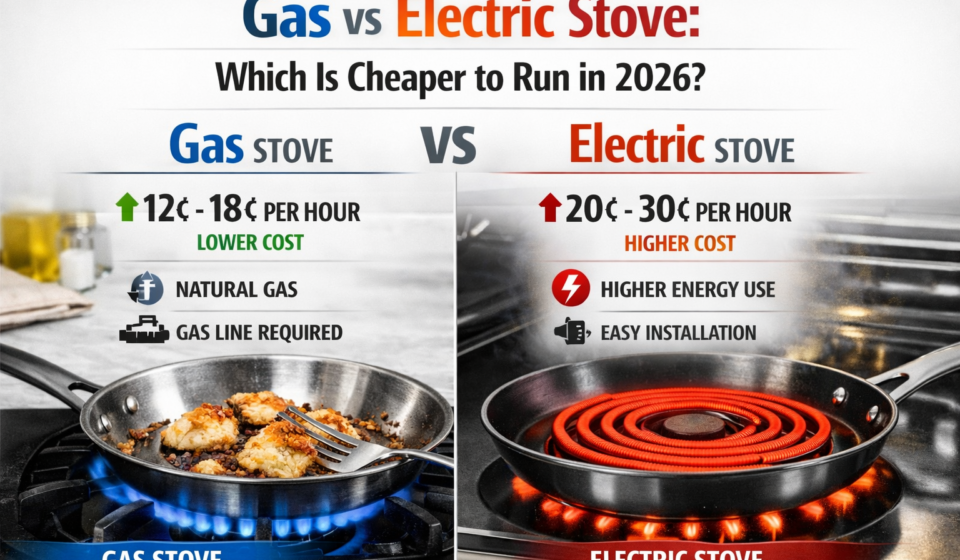

Gas vs Electric Stove: Which Is Cheaper to Run in 2026?
A complete cost‑per‑hour breakdown, energy efficiency comparison, and real‑world usage guide
Choosing between a gas stove and an electric stove isn’t just about cooking style — it’s about long‑term cost, energy efficiency, and how each appliance performs in real‑world kitchens. With rising utility prices in 2026, more homeowners are re‑evaluating which option is truly cheaper to operate.
This guide breaks down cost per hour, monthly usage, efficiency differences, heat output, and hidden costs so you can understand exactly which stove saves more money.
1. Understanding How Each Stove Uses Energy
1.1 How Gas Stoves Use Energy
Gas stoves burn natural gas or propane to produce heat.
Energy is measured in BTUs (British Thermal Units).
Typical gas burner output:
- Low burner: 5,000 BTU
- Standard burner: 9,000–12,000 BTU
- High‑power burner: 15,000–20,000 BTU
Gas stoves lose a lot of heat to the air — only 35–40% of the energy actually reaches the pan.
1.2 How Electric Stoves Use Energy
Electric stoves use resistance coils or radiant glass‑top elements.
Typical wattage:
- Small burner: 1,200W
- Medium burner: 1,500W
- Large burner: 2,000–2,500W
Electric stoves are more efficient than gas, transferring 70–75% of heat to the cookware.
2. Cost to Run a Gas Stove vs Electric Stove (2026)
To compare costs, we calculate:
- Gas: BTU → therms → cost
- Electric: watts → kWh → cost
Using 2026 U.S. average utility rates:
- Electricity: 17¢ per kWh
- Natural gas: $1.70 per therm
3. Cost Per Hour Comparison
3.1 Gas Stove Cost Per Hour
A standard 12,000 BTU burner uses:
12,000 BTU ÷ 100,000 = 0.12 therms per hour
Cost: 0.12 × $1.70 = 20.4 cents per hour
High‑power burner (18,000 BTU): 18,000 ÷ 100,000 × $1.70 = 30.6 cents per hour
3.2 Electric Stove Cost Per Hour
A typical 1,500W burner uses:
1.5 kWh × 17¢ = 25.5 cents per hour
A large 2,500W burner: 2.5 kWh × 17¢ = 42.5 cents per hour
4. Which Is Cheaper Per Hour?
Winner: Gas (slightly)
Gas stoves cost 20–30 cents per hour, while electric stoves cost 25–43 cents per hour.
But this is only part of the story.
5. Efficiency Changes the Real Cost
Gas loses more heat to the air.
Electric transfers more heat to the pan.
Effective cooking efficiency
- Gas: 35–40%
- Electric: 70–75%
This means:
Electric stoves cook faster and waste less heat.
So even though electric costs more per hour, it often costs less per meal because it finishes sooner.
6. Real‑World Cost Per Meal
Assuming a 20‑minute cooking session:
Gas stove
- 20.4 cents per hour → 6.8 cents per meal
Electric stove
- 25.5 cents per hour → 8.5 cents per meal
Difference: 1.7 cents per meal
Over a month of daily cooking: ~50 cents difference
In real‑world usage, the cost difference is tiny.
7. Hidden Costs Most People Forget
7.1 Gas Stoves Require Ventilation
Gas produces:
- Carbon monoxide
- Nitrogen dioxide
- Combustion byproducts
Running a vent hood increases electricity usage.
7.2 Electric Stoves Have Higher Upfront Costs
Electric stoves often cost more to purchase and install, especially if you need:
- A 240V outlet
- Electrical panel upgrades
7.3 Gas Prices Fluctuate Seasonally
Winter spikes can raise gas costs by 20–40%.
7.4 Electric Stoves Are Better for Small Kitchens
Less ambient heat = lower AC usage in summer.
8. Performance Differences That Affect Cost
8.1 Gas Pros
- Instant heat control
- Better for high‑heat cooking
- Works during power outages
- Cheaper per hour
8.2 Gas Cons
- Wastes heat
- Requires ventilation
- Can raise indoor temperatures
- Flame can scorch cookware
8.3 Electric Pros
- More energy‑efficient
- Even heat distribution
- Easier to clean
- Lower indoor heat output
8.4 Electric Cons
- Slower to adjust temperature
- Higher cost per hour
- Requires 240V outlet
9. Which Stove Is Cheaper Overall?
Short answer: Gas is slightly cheaper to run, but electric is more efficient.
Long answer:
- Gas costs less per hour
- Electric uses energy more efficiently
- Real‑world cost difference is small
- Kitchen size, ventilation, and cooking style matter more
For most households, the difference is $5–$15 per year.
Conclusion
In 2026, gas stoves remain slightly cheaper to operate, but electric stoves are more efficient, safer, and often cheaper per meal due to faster, more consistent heating. The cost difference is small enough that your choice should be based on cooking style, kitchen layout, and personal preference — not utility bills.