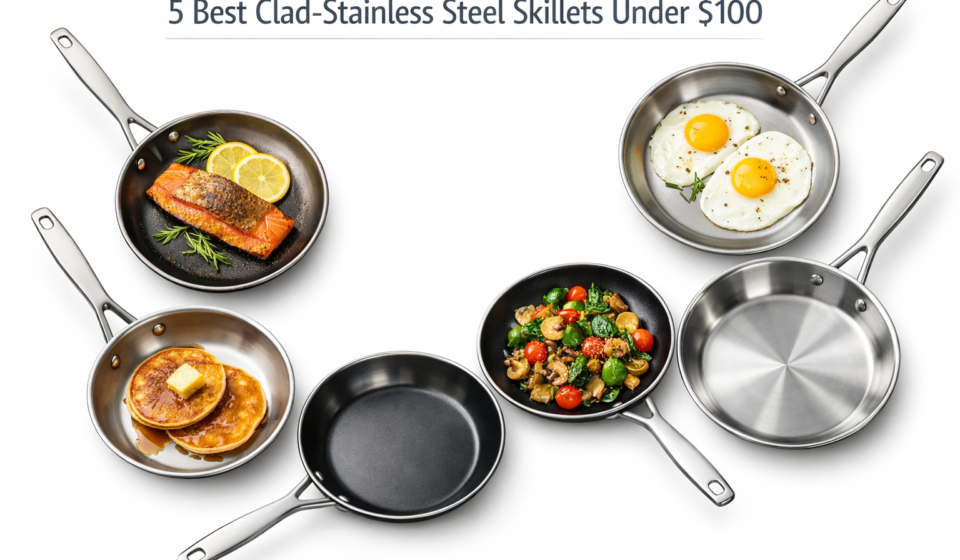

The 5 Best Clad-Stainless Steel Skillets Under $100
In the world of professional cooking, the fully clad stainless steel skillet is the undisputed workhorse. Unlike fragile non-stick pans that degrade after a year or two, a premium stainless steel skillet is an heirloom-quality tool built for life. It can withstand intense heat, metal utensils, and vigorous scrubbing, all while delivering the incredible thermal performance required to build a flawless, golden crust on a steak or deglaze a deeply flavorful pan sauce.
For decades, accessing top-tier cladded cookware meant spending a fortune. Premium legacy brands built their reputations on $150 to $250 individual frying pans.
Fortunately, direct-to-consumer innovations and precise metallurgical manufacturing have shattered that luxury barrier. You no longer have to pay a massive brand markup to get industrial-grade thermal engineering. You can easily find a world-class, fully cladded pan that stands shoulder-to-shoulder with luxury house standards for a double-digit price.
This detailed guide breaks down the physics of clad cookware engineering and reviews the 5 best fully clad stainless steel skillets you can buy right now for under $100.
The Metallurgy of “Cladding”: Why It Matters
To find a true bargain, you must first understand the structural difference between a cheap stockpot and a high-performance clad skillet.
Stainless steel is an incredible material for kitchenware because it is non-reactive, highly scratch-resistant, rust-proof, and practically indestructible. However, from a physics standpoint, stainless steel is a terrible conductor of heat. If you build a pan out of pure stainless steel, it will develop extreme hot spots directly above the flame, leading to unevenly scorched proteins and ruined sauces.
To solve this physical limitation, manufacturers use cladding. Cladding is a heavy metallurgical forging process where sheets of highly conductive metals—usually aluminum or copper—are permanently sandwiched between sheets of premium stainless steel under thousands of pounds of pressure.
Fully Clad vs. Impact-Bonded Bases
When shopping on a budget, you will run across two entirely different manufacturing methods:
-
Impact-Bonded Bases (Disc-Bottomed): The manufacturer builds a cheap, single-ply stainless steel pan and slaps a thick disc of aluminum onto the very bottom. While this bottom disc distributes heat across the floor of the pan, the heat stops abruptly at the lower edge. The side walls of the skillet remain cold, single-ply steel, causing food to scorch along the interior corners where the floor meets the wall.
-
Fully Clad (Tri-Ply or 5-Ply): The composite sandwich of stainless steel and aluminum extends continuously from the base all the way up the side walls to the very rim. This creates a uniform, wrap-around thermal envelope. The entire interior of the pan heats at exactly the same rate, providing complete temperature control and preventing perimeter burning.
To get professional-grade results, always demand fully clad construction.
The Blueprint of the Perfect Clad Skillet
+-----------------------------------------------------------------------+
|                    THE ARCHITECTURAL CLAD SKILLET GRID                 |
+-----------------------------------------------------------------------+
| PERFORMANCE ELEMENT   | THE PROFESSIONAL SPECIFICATION                |
+-----------------------+------------------------------------------------+
| Metal Core            | Multi-Ply Aluminum Core extending to the rim   |
| Surface Alloy         | 18/10 Surgical Grade Stainless Steel Interior  |
| Rim Edge              | Flared/Rolled Rim for drip-free pouring       |
| Handle Mechanics      | Cast Stainless Steel, securely double-riveted |
+-----------------------+------------------------------------------------+
Top 5 Clad-Stainless Steel Skillets Under $100
The following individual pans deliver exceptional cladded performance, high-quality material purity, and excellent weight balance—all while keeping your budget firmly under the $100 threshold.
1. The Value King: Tramontina Gourmet Tri-Ply Clad 10-Inch or 12-Inch Skillet
For over a decade, commercial chefs and kitchen testers have praised the Tramontina Gourmet Tri-Ply Clad series as the ultimate alternative to high-end luxury brands.
+-----------------------------------------------------------------------+
|                    MATERIAL COMPARISON SPECIFICATIONS                 |
+-----------------------------------------------------------------------+
| SKILLET               | CORES / PLYS    | RETAIL PRICE (approx.)       |
+-----------------------+-----------------+------------------------------+
| Tramontina Gourmet    | 3-Ply Full Clad | $40 - $55                    |
| Misen Full Clad       | 5-Ply Full Clad | $89 - $99                    |
| All-Clad D3 (10-Inch) | 3-Ply Full Clad | $99 - $100                   |
| Cuisinart MultiClad   | 3-Ply Full Clad | $50 - $65                    |
+-----------------------+-----------------+------------------------------+
The Construction
Manufactured in Brazil, this pan features a robust tri-ply architecture: a high-purity aluminum core bound between an interior layer of 18/10 surgical stainless steel and an exterior layer of magnetic stainless steel. The cladding runs seamlessly up the side walls to the edge.
Performance & Ergonomics
In thermal testing, the Tramontina matches pans three times its price, exhibiting minimal temperature variance across its surface. It features a beautifully flared rim that makes pouring hot pan sauces or oils clean and drip-free. The cast-stainless handle is securely attached with heavy dual rivets, offering a traditional, secure grip.
-
Oven Safety: Up to 500°F (260°C).
-
Best For: Cooks who want a professional tool that matches luxury performance at a rock-bottom price.
2. The Heavyweight 5-Ply Contender: Misen 10-Inch Full Clad Skillet
Misen entered the market with a direct-to-consumer philosophy: eliminate wholesale markups and put professional-grade steel into the hands of home cooks. Their flagship skillet is a triumph of modern engineering.
The Construction
While most budget pans stop at tri-ply construction, Misen delivers a 5-ply fully clad composite. It utilizes an internal core featuring three separate layers of premium aluminum alloys, completely encased in thick stainless steel. This added metal mass makes the pan slightly heavier, but it provides incredible thermal retention and structural resistance to warping under extreme heat.
Performance & Ergonomics
The Misen skillet is a searing powerhouse. Thanks to its thick 5-ply core, it holds onto heat beautifully when a cold steak or pork chop hits the pan, preventing the temperature drops that cause meat to steam rather than sear. It features a unique, custom-rounded ergonomic handle with a subtle thumb indentation, giving you excellent physical leverage and comfort when tossing ingredients.
-
Oven Safety: Up to 500°F (260°C).
-
Best For: Cooks who want heavy-duty 5-ply thermal mass and modern handle ergonomics.
3. The Iconic Benchmark: All-Clad D3 Stainless 10-Inch Frying Pan (On Promotion)
All-Clad is the legendary brand that invented fully clad cookware technology. While their larger 12-inch pans or multi-piece sets cost hundreds of dollars, their essential D3 10-inch skillet can frequently be found on sale right at the $99 to $100 mark.
The Construction
The D3 features a classic, beautifully balanced three-layer bonded configuration. A thick, heat-responsive aluminum core is sandwiched between a high-polished 18/10 stainless cooking surface and a durable magnetic steel exterior base.
Performance & Ergonomics
The D3’s reputation is built on its lightning-fast responsiveness. When you adjust the dial on an induction or gas stove, the internal core reacts instantly, allowing you to quickly drop the heat to prevent a delicate garlic reduction from burning. It features All-Clad’s signature straight, concave handle channel. While some find the rigid handle profile polarizing, it is engineered explicitly to prevent the pan from twisting in your hand when pouring heavy liquids.
-
Oven Safety: Up to 600°F (315°C).
-
Best For: Home cooks who want an iconic, lifetime piece of American culinary history at a double-digit entry point.
4. The Architectural Workhorse: Cuisinart MultiClad Pro 12-Inch Skillet
If you need a large, family-sized 12-inch frying pan but need to keep your budget well under $100, the Cuisinart MultiClad Pro (MCP) is a stellar, high-yield choice.
The Construction
Do not confuse the MultiClad Pro line with Cuisinart’s cheaper “Chef’s Classic” line (which features a cheap impact-bonded disc base). The MultiClad Pro is a true, fully clad tri-ply masterpiece. It features an exceptionally flat exterior base profile that ensures excellent, flush surface contact across modern glass-top induction and electric stoves.
Performance & Ergonomics
The MCP 12-inch skillet boasts an oversized cooking floor that lets you cook multiple chicken thighs at once without crowding the pan. It features a unique, cast-stainless steel stay-cool handle with an aggressive upward angle that keeps your hand far away from the heat source. Additionally, it features a tapered, rolled rim designed for clean pouring.
-
Oven Safety: Up to 550°F (287°C).
-
Best For: Large families who need maximum surface area and a true wrap-around thermal core.
5. The Minimalist Modernist: Goldilocks 10-Inch Stainless Steel Skillet
Goldilocks is a younger direct-to-consumer brand built on a refreshing ethos: strip away unnecessary marketing jargon and offer a highly functional, beautifully balanced pan at a fair, honest price.
The Construction
This pan features a clean, minimalist tri-ply clad design that balances weight and thermal efficiency perfectly. At around 2.8 pounds, it sits in a sweet spot—heavy enough to resist warping and retain heat, yet nimble enough to flip a delicate omelet with a simple flick of the wrist.
Performance & Ergonomics
The Goldilocks pan features an exceptionally smooth, high-luster interior finish that releases food easily once you master proper thermal preheating techniques. Its handle is completely rounded and smoothed down, eliminating sharp edges or deep channels to offer one of the most comfortable, soft-feeling grips in the value segment.
-
Oven Safety: Up to 500°F (260°C).
-
Best For: Urban cooks, apartment dwellers, and minimalists who appreciate clean aesthetics and nimble handling.
3 Rules for Cooking with Stainless Steel Without Sticking
The biggest complaint home cooks have when transitioning from cheap non-stick pans to professional stainless steel is that food sticks to the surface. However, sticking is not a fault of the pan; it is a symptom of incorrect thermal technique.
Because stainless steel has microscopic pores on its surface, cold metal will grab onto food proteins. Follow these three simple scientific rules to create a naturally non-stick surface:
1. Master the Leidenfrost Preheating Test
Always preheat your dry clad skillet over medium heat for 2 to 3 minutes before adding any fats or ingredients. To verify if the pan is ready, drop a single bead of water onto the dry steel surface.
-
If the water fizzes and evaporates instantly, the pan is too cold.
-
If the water splits into dozens of tiny bubbles that skitter around chaotically, the pan is too hot.
-
If the water forms a single, coherent glass-like bead that floats effortlessly across the steel like a hovercraft, you have achieved the Leidenfrost Effect. The pan’s surface pores have expanded and flattened out, creating a uniform thermal barrier.
[Image demonstrating the Leidenfrost effect with a water droplet gliding smoothly on a heated stainless steel surface]
2. Heat Your Oil Until It Shimmers
Once your pan passes the Leidenfrost test, wipe out the water bead and add your cooking oil or butter. Let the fat heat inside the pan for 30 seconds. You will see the oil thin out and form elegant, wavy patterns across the steel—this is known as shimmering. When the oil shimmers, it has filled in any remaining microscopic valleys in the steel, creating an incredibly slick coating.
3. Let the Meat Self-Release
When you drop a piece of protein (like a chicken breast, salmon fillet, or steak) into a hot clad pan, it will naturally stick to the surface initially. Do not panic, and do not force it loose with a spatula.
As the conductive core delivers heat to the meat, sugars and proteins undergo the Maillard reaction, forming a crisp, caramelized crust. Once this crust forms completely, the meat will naturally release itself from the steel. If you try to flip it and it resists, it is simply telling you it hasn’t finished searing yet. Give it another 60 seconds, and it will release cleanly.
Summary: Strategic Value Blueprint
Investing in a premium kitchen setup doesn’t require spending thousands of dollars on highly marketed designer brands. By targeting fully clad structural engineering, you can bypass the luxury markup and score a professional tool built to last a lifetime.
+-------------------------------------------------------------------------+
|                    CLAD SKILLET INVESTMENT MATRIX                       |
+-------------------------------------------------------------------------+
|  WHAT TO LOOK FOR:                                                      |
|  [ Full Cladding to the Rim ] ---> Guarantees zero scorched edge zones  |
|  [ High-Purity Aluminum Core ] ---> Delivers fast, uniform heat flow    |
|                                                                         |
|  WHAT TO IGNORE:                                                        |
|  [ Luxury Brand Badges ] ---> Adds zero performance to your searing     |
|  [ Impact Disc Bases ] ---> Scorches your perimeter pan sauces          |
+-------------------------------------------------------------------------+
Choose the pan from this list that best matches your weight preferences and family size, master the Leidenfrost preheating technique, and enjoy the incredible, lifetime reward of cooking on professional-grade cladded stainless steel!