
How to Restore a Rusted Cast Iron Skillet in 3 Steps
It is a heartbreaking discovery that happens to almost every home cook at some point. You pull open a damp cabinet, look into the back of your pantry, or uncover a box from a garage sale, only to find a once-beautiful cast iron skillet covered in a flaky, rough, orange coat of rust.
Your first instinct might be to assume the pan is dead. Traditional non-stick pans or modern ceramic cookware are ruined the moment their surface integrity is compromised. If a Teflon pan scratches or flakes, it belongs in a landfill.
But cast iron is a completely different beast. Cast iron is fundamentally an indestructible, solid chunk of raw metal alloy. Unless the skillet is physically cracked completely in half or severely warped from industrial thermal abuse, it is never truly dead.
That terrifying layer of orange rust is entirely superficial. It is merely a surface chemical reaction that occurs when bare iron is exposed to moisture and oxygen without a protective coating. Beneath that crusty, unsightly exterior lies the exact same high-performance cooking tool that your grandparents used.
You do not need to throw it away, and you don’t need specialized industrial equipment to fix it. With a few cheap household items, a little bit of physical effort, and two hours of time, you can completely reset the metal and restore a rusted skillet back to a smooth, pitch-black, non-stick finish.
This comprehensive, 2000-word deep-dive guide will take you through the precise 3-step restoration process—Strip, Scrub, and Season—explaining the science behind each step to guarantee your heirloom pan lives to sear another day.
The Chemistry of Cast Iron: Why Rust Happens
To restore your pan correctly, you must understand your enemy. Why did your beautiful black skillet turn into an orange nightmare?
The signature black, slippery finish of a healthy cast iron pan isn’t paint, and it isn’t a factory coating. It is a layer of polymerized fat, commonly known as seasoning. When cooking oil is applied to raw iron and heated past its smoke point, it undergoes a chemical transformation. The liquid fat molecules cross-link and bond to one another, transforming into a hard, plastic-like solid that fills the microscopic pores of the iron. This layer blocks water and oxygen from touching the raw metal underneath.
If a pan is washed incorrectly, left sitting in a wet sink, stored in a humid environment, or put away completely dry without a protective micro-layer of oil, that seasoning barrier breaks down.
The moment bare, unprotected iron ($Fe$) comes into contact with oxygen ($O_2$) and water ($H_2O$), a chemical reaction called oxidation occurs. The iron atoms shed electrons to the oxygen molecules, creating a new compound: hydrated iron(III) oxide ($Fe_2O_3 \cdot H_2O$), otherwise known as rust.
Because rust has a much larger molecular volume than the raw iron it replaces, it expands, blisters, and flakes away, exposing a fresh layer of raw iron underneath to be oxidized. If left unchecked for decades, rust can slowly eat through a pan. But if caught on the surface, removing it is incredibly simple. Your goal in this restoration is to chemically and mechanically strip away the oxidized iron molecules, exposing the healthy, raw metal underneath, and immediately sealing it with a fresh, permanent layer of polymerized seasoning.
The Restoration Toolkit: Everything You Need
Before beginning, gather your supplies. You do not need expensive specialized chemical rust-removers. The best tools are cheap, effective, and likely already sitting under your kitchen sink.
+-----------------------------------------------------------------------+
|                       THE RESTORATION TOOLKIT                         |
+-----------------------------------------------------------------------+
| CATEGORY              | ITEM NEEDED                                   |
+-----------------------+-----------------------------------------------+
| The Stripping Agent   | Standard white distilled vinegar (1-2 gallons)|
| The Mechanical Scrub  | Fine steel wool (Grade 00 or 000)             |
| The Lubricant         | Standard blue dish soap (Dawn or equivalent)  |
| The Drying Agent      | Clean paper towels & a stovetop burner        |
| The New Seasoning Oil | Grapeseed, Crisco, or canola oil              |
+-----------------------+-----------------------------------------------+
-
White Vinegar: The cheap, standard 5% acidity vinegar from the grocery store is your chemical secret weapon. Acetic acid is highly effective at dissolving iron oxide while leaving raw iron relatively unharmed if managed correctly.
-
Fine Steel Wool: Avoid ultra-coarse steel scrubbers that leave deep scratches. Opt for Grade 00 or 000 fine steel wool, which provides enough friction to erase rust without gouging the iron.
-
The Right Oil: For the re-seasoning step, skip expensive gourmet oils like extra virgin olive oil or unrefined coconut oil. They have low smoke points and contain organic solids that burn and flake. Instead, choose a highly unsaturated fat with a high smoke point, such as grapeseed oil, Crisco vegetable shortening, or standard canola oil. Grapeseed oil is highly favored by cast iron enthusiasts because its molecular structure allows it to polymerize into a exceptionally hard, durable coating.
Step 1: The Strip (The Chemical Cleanse)
The first step is removing both the residual, degraded old seasoning and the loose surface rust. While mechanical scrubbing can remove some rust, a chemical soak guarantees that the acid reaches deep into the microscopic pores of the metal, neutralizing the oxidation completely.
The Vinegar-Water Bath Solution
Find a vessel large enough to fully submerge your skillet. A large plastic bucket, a storage tote, or even your kitchen sink will work perfectly.
Mix a solution of 50% white distilled vinegar and 50% warm water.
CRITICAL SAFETY WARNING: Never soak a cast iron pan in pure, undiluted vinegar, and never leave it in a vinegar bath indefinitely. While acetic acid eats rust for breakfast, it will eventually begin to eat the raw iron itself once the rust is gone. This process, called pitting, creates permanent, microscopic craters in your pan that will make food stick forever.
The Soak Timeline
Submerge the skillet completely in the 50/50 solution. You will instantly see tiny streams of bubbles rising from the rusty patches—this is the acetic acid reacting with the iron oxide, breaking its molecular bond.
Check the pan every 20 to 30 minutes. For light, localized surface rust, a quick 30-minute soak is often all it takes. For severe, crusty, vintage garage-sale rust, the pan may need up to 2 to 4 hours.
Pull the pan out periodically and wipe it with a rag. The moment the orange rust begins to easily wipe away down to raw, gray-black iron, the chemical strip is complete. Pull the pan out of the bath immediately.
Step 2: The Scrub (The Mechanical Polish)
Once the vinegar has loosened the structural hold of the rust, you must immediately transition to the mechanical cleaning phase to remove the dissolved sludge and smooth out the underlying metal surface.
The Raw Metal Scrub down
Take the skillet directly to your sink. Squirt a generous amount of standard blue dish soap into the pan and grab your fine steel wool.
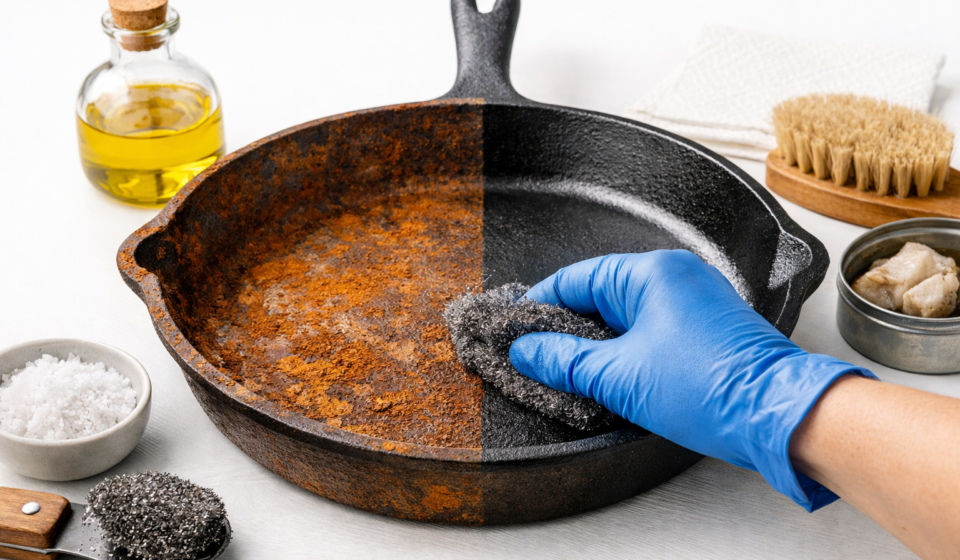
Begin scrubbing the entire pan aggressively. Do not just focus on the interior cooking surface; scrub the sidewalls, the handle, the helper handle, and the entire exterior bottom of the skillet. The combination of the fine steel wool and the lubricating dish soap will lift away the remaining rust particles and dissolve any sticky, half-degraded old grease layers.
As you scrub, rinse the pan under cold running water frequently to wash away the black and orange sludge. Keep scrubbing until the pan undergoes a complete color transformation: it should change from a muddy orange-brown to a uniform, dull, matte slate-gray. This slate-gray color is the true appearance of raw, naked cast iron.
The Flash-Rust Emergency
The moment you finish rinsing the raw gray iron pan and wipe it with a towel, you will notice something terrifying: a light, faint layer of orange tint can reappear on the metal within 30 seconds.
This is known as flash rust. Naked iron is so incredibly reactive to oxygen that it will begin to oxidize almost instantly in the ambient air while wet.
To prevent flash rust from ruining your hard work, follow this protocol:
-
Wipe the pan dry with a paper towel as fast as possible.
-
Place the skillet directly onto a stovetop burner over Medium heat for 2 to 3 minutes.
-
The intense heat will force every single drop of trapped moisture out of the porous metal, evaporating it into the air.
Once the pan is hot and bone-dry, it is completely stabilized and ready for the final, transformative step.
Step 3: The Season (The Molecular Rebirth)
Your skillet is now completely clean, but it is highly vulnerable. It has zero protection against the atmosphere. If you leave it sitting on your counter overnight in this raw state, it will be completely covered in rust again by morning.
You must immediately apply a fresh, multi-layered coat of seasoning to seal the iron permanently.
+-----------------------------------------------------------------+
|                  THE PERFECT SEASONING PROTOCOL                 |
+-----------------------------------------------------------------+
| 1. APPLY OIL  -> Pour 1 tsp of oil into a warm, bone-dry pan.   |
| 2. BUFF DRY   -> Use a clean paper towel to wipe 99% of it off. |
|                  (The pan should look completely matte/dry!)    |
| 3. BAKE IN    -> Place upside down in a preheated 450°F oven.   |
| 4. TIME IT    -> Bake for exactly 60 minutes, then cool slowly.  |
+-----------------------------------------------------------------+
The Secret of the Micro-Coat
Preheat your kitchen oven to 450°F (230°C).
While the oven heats, take your warm skillet off the stove. Pour roughly one teaspoon of your chosen seasoning oil (like grapeseed oil) into the center of the pan. Using a paper towel, rub the oil across every square inch of the skillet—interior, exterior, handles, and bottom. The pan will look shiny and wet.
Now, grab a fresh, completely dry paper towel. Attempt to wipe every single drop of oil back out of the pan.
This is where most beginners fail. They leave a thick, glistening coat of oil in the pan, thinking more oil equals more non-stick protection. But thick layers of oil do not polymerize correctly; they turn into a sticky, gummy, brown varnish that smells bad and easily flakes off into your food.
You want a microscopic layer of oil. Wipe the pan until it looks completely dry and matte again. There will still be an invisible, micro-thin film of oil molecules trapped inside the textured pores of the iron, which is exactly what you want.
The Bake Cycle
To prevent the microscopic layer of oil from pooling or running as it heats up, place the skillet upside down on the middle rack of your preheated oven. Place a sheet of aluminum foil or a cheap baking sheet on the bottom rack beneath the skillet to catch any theoretical stray drips.
Bake the skillet at 450°F for exactly 60 minutes. During this hour, the intense heat will force the unsaturated fats in the oil to break apart, re-bond, and link into a slick, hard carbon-polymer matrix that becomes physically unified with the iron surface.
Your kitchen may get a bit smoky during this process—this is completely normal and a sign that the oil is successfully reaching its smoke point to polymerize. Keep your windows open or run your stove’s exhaust fan.
The Slow Cool Down
After one hour, turn off the oven. Do not open the oven door.
Let the skillet sit inside the cooling oven for at least an hour to come down to room temperature gradually. Allowing the pan to cool slowly lets the newly formed polymer layer stabilize and temper against the iron base without experiencing any sudden thermal stress.
When you pull the pan out, it will no longer look slate-gray. It will feature a beautiful, dark, satiny-amber or semi-black sheen.
Repeat for Ultimate Slickness
A single round of seasoning creates a great foundational shield against rust, but it won’t be fully non-stick yet. To build up that legendary, mirror-smooth factory finish, repeat Step 3 two or three more times.
Simply apply another teaspoon of oil, wipe it completely dry, bake it at 450°F for an hour, and let it cool. With each subsequent layer, the pan will turn darker and glossier until it is a deep, uniform, magnificent obsidian black.
4 Rules to Keep Your Restored Pan Rust-Free Forever
Now that your skillet has been brought back from the dead, you want to ensure you never have to repeat this restoration process again. Maintain your seasoning shield by following these four non-negotiable rules of cast iron care:
1. Never Let It Soak in the Sink
The kitchen sink is the natural enemy of cast iron. Never leave your skillet sitting in water overnight or piling up under wet dishes. Wash your pan immediately after cooking, or leave it sitting dirty on a cool stove burner until you are ready to clean it.
2. The 60-Second Heat-Dry Rule
Never air-dry cast iron on a drying rack. Evaporation takes time, and lingering water drops will quickly break down your seasoning layer. After washing your pan, wipe it with a towel, and immediately pop it back onto a hot stove burner for 60 seconds until the metal is piping hot. This completely eliminates moisture from the equation.
3. Apply a Maintenance Coat
Before putting your dry, hot skillet away in the cabinet, apply a single drop of cooking oil to the interior. Take a paper towel and buff it completely across the cooking surface until the pan looks clean and slightly lustrous. This acts as a secondary atmospheric barrier that protects your seasoning while the pan sits in storage.
4. Avoid Acidic Foods Initially
For the first month of cooking on your newly restored pan, stick to high-fat foods. Cook bacon, sear steaks, fry chicken, or sauté onions. Avoid cooking highly acidic ingredients like tomato sauces, vinegar reductions, or heavy lemon juices. Concentrated acids will eat away at fresh, young seasoning layers. Wait until your pan has a thick, seasoned foundation built up over months of frying before introducing acids.
The Ultimate Kitchen Workhorse
Restoring a rusted cast iron skillet is a deeply satisfying culinary rite of passage. It teaches you an important lesson about your kitchen tools: high-quality gear doesn’t need to be fragile, disposable, or coddled.
By taking a rusted, abandoned piece of metal and investing a little bit of time into stripping, scrubbing, and seasoning it, you aren’t just saving a few bucks on a replacement pan. You are reclaiming a durable piece of history that is fundamentally engineered to outlive you. Treat your restored skillet with respect, keep it dry, cook with plenty of real fats, and enjoy the flawless, chemical-free searing power of your revived kitchen icon!