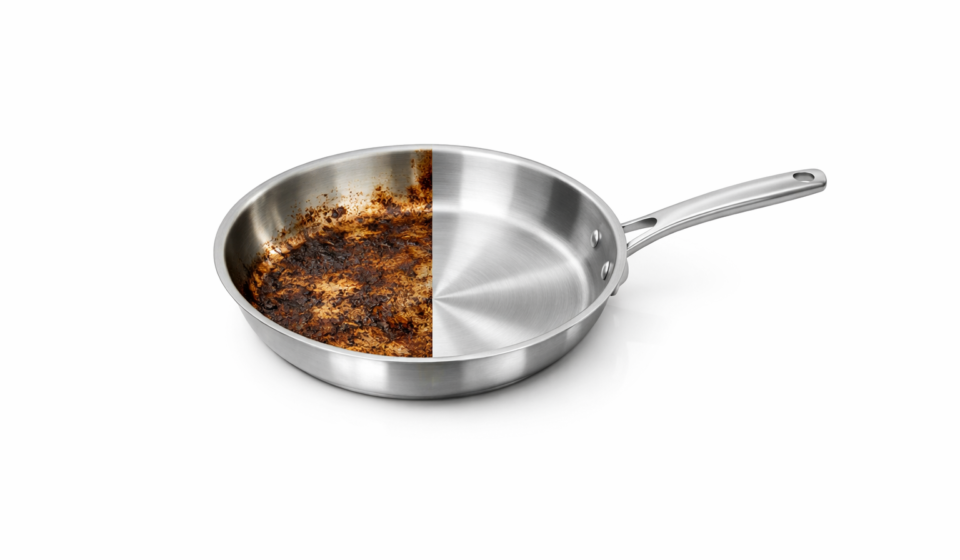

It is a frustrating moment that every home cook faces. You finish searing a beautiful piece of protein or simmering a rich sauce in your premium stainless steel pan, only to find a dark, stubborn ring of amber or pitch-black carbonized grease baked onto the surface.
This isn’t just standard food residue that slides off with a bit of dish soap and a sponge. This is polymerized oil—the exact same chemical matrix that cast iron cooks explicitly try to build up to season their pans. When cooking oil is exposed to high heat on stainless steel for too long, it undergoes a chemical transformation, cross-linking into a tough, plastic-like varnish that physically bonds to the metal.
Your first instinct might be to reach for a heavy metal scouring pad or an aggressive abrasive cleanser and start scrubbing with brute force. Stop right there. Aggressive, dry mechanical scrubbing can permanently scratch the polished finish of high-end stainless steel (like All-Clad or Demeyere), creating microscopic grooves that will cause food to stick even worse during your next cooking session.
You do not need to ruin your arms or your cookware. Because stainless steel is incredibly resilient, you can use basic kitchen chemistry to dissolve, lift, and float that burned-on grease away with minimal scrubbing.
This comprehensive guide will walk you through the absolute best, scientifically backed methods to clean burned-on grease from stainless steel using simple household items, ranked from the easiest daily maintenance fix to the ultimate deep-clean protocol for severely neglected pans.
The Chemistry of Burned-on Grease: Know Your Enemy
To clean a pan efficiently, you have to understand what you are actually fighting. Burned-on grease is essentially cooking oil that has exceeded its thermal limit. As it heats up, the volatile moisture and light organic compounds evaporate into the air, leaving behind a dense, sticky layer of pure carbon and polymerized lipids.
Because this residue is highly hydrophobic (water-repelling), standard dish soap cannot penetrate it effectively. To break it down, you must deploy one of two chemical strategies:
-
Alkaline Degreasing (Base): High-pH bases break apart the polymer bonds of oxidized fats, turning the hard varnish back into a soft, water-soluble soap-like compound. This process is called saponification.
-
Acidic Decalcification (Acid): Low-pH acids work wonders at breaking down mineral bonds and loosening the grip that carbonized proteins have on the chromium oxide layer of your stainless steel.
By pairing these chemical reactions with thermal energy (heat), you can clean a pan in minutes that would otherwise take hours of manual scrubbing.
Method 1: The Boiling Baking Soda Bath (Best for General Daily Discoloration)
If your pan has a broad layer of sticky, amber-brown grease baked across the interior floor or inner walls, the absolute best method is an alkaline boil using standard baking soda ($NaHCO_3$).
+-----------------------------------------------------------------+
|               THE BAKING SODA BOIL PROTOCOL                     |
+-----------------------------------------------------------------+
| 1. FILL    -> Add water to the pan until the grease is covered. |
| 2. ADD BASE -> Dump in 2 to 3 tablespoons of pure baking soda.  |
| 3. BOIL    -> Bring to a rolling boil on the stove for 15 mins. |
| 4. SCRUB   -> Cool slightly and wipe clean with a wooden spoon. |
+-----------------------------------------------------------------+
The Science Behind It
Baking soda is a mild alkali. When you dissolve it in water and heat it to a boil, the thermal energy accelerates its base properties, allowing it to gently attack and soften the outer layers of the polymerized oil without pitting or etching the stainless steel underneath.
Step-by-Step Instructions:
-
Fill the Pan: Pour water into the dirty pan until all the burned-on grease rings are completely submerged under at least an inch of water.
-
Add the Baking Soda: Add 2 to 3 generous tablespoons of baking soda directly to the water. Give it a quick stir.
-
Bring to a Boil: Place the pan on your stovetop over high heat and bring the solution to a rolling boil. Once it starts boiling, reduce the heat to medium-low and let it simmer for 15 to 20 minutes.
-
Scrape While Wet: As the water bubbles, take a sturdy wooden spoon or a nylon spatula and gently scrape at the black spots. You will notice the black carbon beginning to flake off and float into the murky water automatically.
-
Rinse and Wipe: Pour the dirty water down the drain. Let the pan cool until it is safe to touch, then wipe the remaining residue away using a standard kitchen sponge and warm water.
Method 2: The Vinegar and Baking Soda Volcanic Scrub (Best for Heavy Carbon Crusts)
If someone accidentally left a pan on a high-output gas burner for an hour and the grease has turned into a crusty, obsidian-black, charcoal-like layer, you need a dual-action chemical reaction that combines an acid with a base.
+-----------------------------------------------------------------+
|                  THE DUAL-ACTION CHEMICAL CRUSH                 |
+-----------------------------------------------------------------+
| WATER + VINEGAR (Boil)  -> Acid breaks down carbonized proteins.|
|          +                                                      |
| BAKING SODA (Post-Boil) -> Effervescent fizzing lifts flakes.   |
+-----------------------------------------------------------------+
The Science Behind It
This method utilizes white distilled vinegar (acetic acid) to attack the mineral and protein bonds holding the carbon to the steel. Then, when you add baking soda to the wet pan, it creates a violent chemical reaction that releases carbon dioxide gas ($CO_2$). This rapid, effervescent fizzing acts as a thousands-of-miniature-jackhammers mechanical force, lifting the softened carbon flakes completely off the metal surface.
Step-by-Step Instructions:
-
The Acid Boil: Fill the bottom of the pan with equal parts water and white distilled vinegar (a 50/50 mix). Bring the mixture to a boil on the stove and let it simmer for 10 minutes.
-
Remove from Heat: Turn off the burner and slide the pan onto a heat-safe surface.
-
The Volcano Effect: While the liquid is still hot, dump 2 tablespoons of baking soda directly into the vinegar water. The pan will instantly erupt in a massive, foaming fizz. Let the foam sit and do its work for 5 minutes as it cools down.
-
The Paste Scrub: Pour out the liquid, leaving just a tiny bit of wet baking soda slurry at the bottom. The baking soda will now act as a completely safe, micro-abrasive paste. Take a non-scratch scrub sponge (like a Scotch-Brite Blue pad) and rub the paste over the black stains. The carbon crust will crumble away effortlessly.
Method 3: Bar Keepers Friend (The Ultimate Professional Deep Clean)
If you ask any professional chef or stainless steel cookware manufacturer how to keep their pans looking brand new, they will all give you the exact same three-word answer: Bar Keepers Friend.
+-----------------------------------------------------------------------+
|                       THE PRO DEEP-CLEAN TOOLKIT                      |
+-----------------------------------------------------------------------+
| PRODUCT               | ACTIVE INGREDIENT   | PRIMARY MECHANISM       |
+-----------------------+---------------------+-------------------------+
| Bar Keepers Friend    | Oxalic Acid         | Chemical Chelation      |
+-----------------------+---------------------+-------------------------+
The Science Behind It
Unlike standard kitchen cleansers that rely on harsh, gritty sand or calcium carbonate to physically scratch grease away, Bar Keepers Friend utilizes oxalic acid.
Oxalic acid is a natural organic compound that works through a process called chelation. It physically bonds to metal oxides and carbonized grease molecules at a molecular level, loosening their chemical grip on the stainless steel. It also magically reverses “heat tint”—those rainbow-like swirls that appear on stainless steel when it is exposed to extreme temperatures—by restoring the reflective chromium oxide layer of the pan.
Step-by-Step Instructions:
-
Wet the Pan: Rinse your pan under warm water to get the surface damp, then pour out the excess water so the metal is just wet, not flooded.
-
Apply the Powder: Sprinkle a generous layer of Bar Keepers Friend powder across the stained areas.
-
Create a Paste: Use a damp sponge to rub the powder around, mixing it with the surface water until it forms a thick, wet paste with the consistency of wet sand.
-
The 2-Minute Rule: Let the paste sit for exactly 1 to 2 minutes. Do not leave it on for longer than two minutes; because oxalic acid is highly effective, leaving it on a pan dry for extended periods can eventually dull or etch the stainless steel’s mirror finish.
-
Scrub and Rinse: Take a non-scratch scrub sponge and rub the paste firmly along the grain of the steel (circular motions for spun finishes, or back-and-forth for linear polishes). The baked-on amber grease will instantly melt into the white paste. Rinse the pan thoroughly with warm water and dry it immediately with a towel.
Method 4: The Garbage Bag Method (For the Absolute Worst Cases)
Every once in a while, you encounter a pan that seems entirely hopeless—perhaps an exterior bottom that has twenty years of built-up, black, rock-hard grease layered over the heat zones. When boiling solutions can’t reach the stain, you need to deploy the heavy artillery: Oven Cleaner.
CRITICAL SAFETY WARNING: Traditional oven cleaners (like Easy-Off) contain sodium hydroxide (lye), which is a highly corrosive, ultra-strong alkaline base. You must wear heavy rubber gloves and eye protection when using this method, and it should only be done outdoors or in a highly ventilated area.
Note: While lye is completely safe to use on heavy-duty stainless steel, never, under any circumstances, use oven cleaner on aluminum cookware, as it will chemically dissolve the aluminum metal and release toxic hydrogen gas.
Step-by-Step Instructions:
-
Prep Your Area: Take the pan outside to a yard or patio, or open your kitchen windows wide and put on thick rubber cleaning gloves.
-
Spray the Pan: Coat the exterior and interior of the stainless steel pan generously with heavy-duty oven cleaner.
-
The Garbage Bag Trap: Immediately slide the sprayed pan inside a heavy-duty plastic garbage bag or a large Ziploc bag, and tie or seal it completely shut. The plastic bag prevents the chemical cleaner from drying out, forcing the active lye to stay wet and aggressively digest the organic carbon polymers over an extended period.
-
Wait it Out: Let the bagged pan sit undisturbed for 2 to 4 hours (or overnight for extreme historical build-up).
-
Wash Clean: Open the bag away from your face to avoid fumes. Take the pan out and rinse it thoroughly under a garden hose or a utility sink faucet. The thick, black, carbonized shell will slide right off the steel like soft jelly, leaving behind a perfectly pristine, shining silver surface. Wash the pan twice with standard dish soap and water before using it to cook again.
3 Things You Should NEVER Do to Clean Stainless Steel
While stainless steel is incredibly durable, it is not completely invincible. Avoid these three common kitchen blunders to ensure you don’t permanently ruin your investment:
1. Avoid Chlorine Bleach
Never use household bleach or any cleansers containing chlorine on stainless steel. Chlorine is highly corrosive to non-magnetic steel alloys. It breaks down the invisible, protective chromium oxide shield that keeps your pan rust-proof, leading to permanent chemical pitting and corrosion that cannot be polished out.
2. Ditch the Coarse Steel Wool (Brillo Pads)
While fine steel wool (like Grade 000) can be used gently in emergency restorations, heavy-duty, coarse steel wool or iron wire scrubbers will leave deep, permanent scratches across the polished finish of your pan. These scratches look unsightly and create tiny physical microscopic valleys where food proteins will catch and burn during future meals, effectively ruining the pan’s performance.
3. Never Thermal Shock a Hot Pan
When you finish cooking and notice a bad grease stain, your immediate instinct might be to rush the blistering hot pan directly from the stove into a sink full of cold water to “shock” the food loose. Never do this.
Stainless steel pans are engineered by bonding multiple layers of different metals (like aluminum, copper, and steel) together. These metals expand and contract at different rates when exposed to temperature changes. Dropping a hot pan into cold water causes thermal shock, which can permanently warp the flat base of your premium cookware or cause the metal layers to delaminate and separate. Always let your pan cool to room temperature naturally before introducing water.
The Ultimate Maintenance Routine
To prevent yourself from ever having to deal with a catastrophic carbon buildup again, establish a simple, preventative cleaning routine.
After every meal, give your pan a standard wash with dish soap. If you notice a light, faint golden hue of grease beginning to form along the inner rivets or walls, don’t ignore it—hit it immediately with a quick sprinkle of Bar Keepers Friend or a spoonful of baking soda during your evening cleanup.
By managing grease build-up when it is fresh and thin, you can keep your stainless steel cookware shining like a mirror and performing at its peak for decades to come!