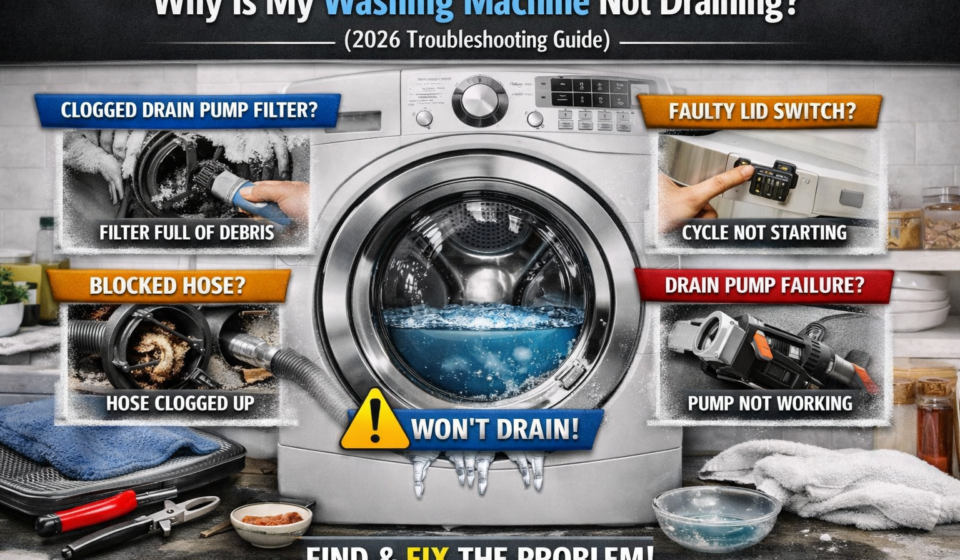

Why Is My Washing Machine Not Draining? (2026 Troubleshooting Guide)
A complete breakdown of clogged pumps, blocked hoses, lid switch failures, drain pump malfunctions, and how to fix a washer that won’t drain
A washing machine that won’t drain is one of the most frustrating laundry problems — clothes stay soaked, cycles stop mid‑way, and the machine may even refuse to spin. The good news: most drainage issues are simple, predictable, and fixable without replacing the washer.
This guide breaks down every reason a washing machine won’t drain, how to diagnose the cause, and the exact steps to fix it safely.
1. First: Identify Your Washer Type
Different washers fail in different ways.
1.1 Top‑Load Washer (Agitator or Impeller)
Common issues:
- Lid switch failure
- Clogged drain hose
- Faulty drain pump
1.2 Front‑Load Washer
Common issues:
- Clogged drain filter
- Blocked pump
- Kinked drain hose
1.3 High‑Efficiency (HE) Washer
Common issues:
- Pump filter blockages
- Sensor errors
- Slow drainage
2. The Most Common Reasons a Washing Machine Won’t Drain
2.1 Clogged Drain Pump Filter (Most Common in Front‑Load Washers)
Front‑load washers have a pump filter that catches:
- Coins
- Hair
- Lint
- Buttons
- Small clothing items
Symptoms:
- Washer won’t drain
- Washer won’t spin
- Error codes (OE, E2, F21, ND, etc.)
- Water pooling at the bottom
Fix:
- Open the pump filter access panel
- Place a towel and shallow pan
- Unscrew the filter
- Remove debris
- Reinstall
This solves 50–70% of drainage issues in front‑load washers.
2.2 Clogged or Kinked Drain Hose (All Washer Types)
The drain hose can become:
- Kinked
- Clogged with lint
- Blocked by small objects
Symptoms:
- Water backing up
- Slow drainage
- Gurgling sounds
Fix:
- Pull washer forward
- Inspect hose for kinks
- Disconnect and flush with water
- Reinstall securely
2.3 Faulty Drain Pump (Very Common)
Drain pumps can fail from:
- Wear
- Debris
- Broken impeller
Symptoms:
- Humming sound but no draining
- Grinding noise
- Water remains after cycle
- Error codes
Fix:
- Replace the drain pump
- Usually a 20–40 minute repair
2.4 Lid Switch Failure (Top‑Load Washers)
Top‑load washers won’t drain or spin if the lid switch fails.
Symptoms:
- Washer stops mid‑cycle
- No draining or spinning
- Clicking sound missing when lid closes
Fix:
- Replace lid switch assembly
This is the #1 cause of drainage failure in older top‑load washers.
2.5 Clogged Coin Trap (Front‑Load Washers)
Some washers have a separate coin trap before the pump.
Symptoms:
- Slow or no drainage
- Rattling noises
- Error codes
Fix:
- Remove trap
- Clean debris
- Reinstall
2.6 Blocked Standpipe or Household Drain
Sometimes the washer is fine — the house drain is clogged.
Symptoms:
- Water overflows from standpipe
- Gurgling in nearby sinks
- Slow drainage throughout home
Fix:
- Clear standpipe
- Use drain snake
- Call plumber if needed
2.7 Faulty Water Level Sensor / Pressure Switch
This sensor tells the washer when to drain.
Symptoms:
- Washer stuck mid‑cycle
- No draining
- Incorrect water levels
Fix:
- Replace pressure switch
- Check pressure hose for blockages
2.8 Control Board Failure (Least Common)
The control board regulates pump operation.
Symptoms:
- Pump doesn’t activate
- Random stopping
- Error codes
Fix:
- Replace control board
- Usually last resort
3. How to Diagnose the Problem (Step‑by‑Step)
Step 1: Check for error codes
Codes often point directly to the issue.
Step 2: Listen for the drain pump
Humming = pump receiving power but jammed.
Silence = pump not receiving power.
Step 3: Inspect the drain hose
Look for kinks or blockages.
Step 4: Clean the pump filter (front‑load)
Most common fix.
Step 5: Check the lid switch (top‑load)
No click = faulty switch.
Step 6: Check for standing water
Indicates pump or hose blockage.
4. Quick Fixes You Can Try Immediately
4.1 Clean the drain pump filter
Solves most front‑load issues.
4.2 Straighten or flush the drain hose
Removes blockages.
4.3 Reset the washer
Unplug for 5 minutes.
4.4 Check the lid switch
Ensure it clicks and engages.
4.5 Remove heavy loads
Unbalanced loads can stop draining/spinning.
5. When to Repair vs Replace
Repair if:
- Pump filter clogged
- Drain hose blocked
- Lid switch failed
- Drain pump failed
- Pressure switch failed
Replace the washer if:
- Control board failure (expensive)
- Multiple components failing
- Washer is 10–15+ years old
- Repairs exceed 50% of replacement cost
Conclusion
A washing machine that won’t drain is almost always caused by a clogged pump filter, blocked drain hose, faulty drain pump, lid switch failure, or pressure sensor issues. Most problems are simple to diagnose and fix at home, especially in front‑load washers where the pump filter catches debris. With proper maintenance and regular cleaning, your washer can drain efficiently and reliably for years.