
Why Does Food Stick to Stainless Steel? (Science‑Based Guide)
A complete breakdown of heat, protein chemistry, pan temperature, oil behavior, and how to make stainless steel truly nonstick
Stainless steel is one of the most durable, versatile, and professional‑grade cookware materials — but it’s also the one that frustrates home cooks the most. If you’ve ever tried to sear chicken, fry eggs, or sauté vegetables only to have everything weld itself to the pan, you’re not alone.
The good news: sticking is not a flaw in stainless steel. It’s a predictable chemical reaction — and once you understand the science, you can make stainless steel behave like a nonstick pan.
This guide breaks down why food sticks, how stainless steel interacts with heat and oil, and how to prevent sticking every time.
1. The Real Reason Food Sticks to Stainless Steel
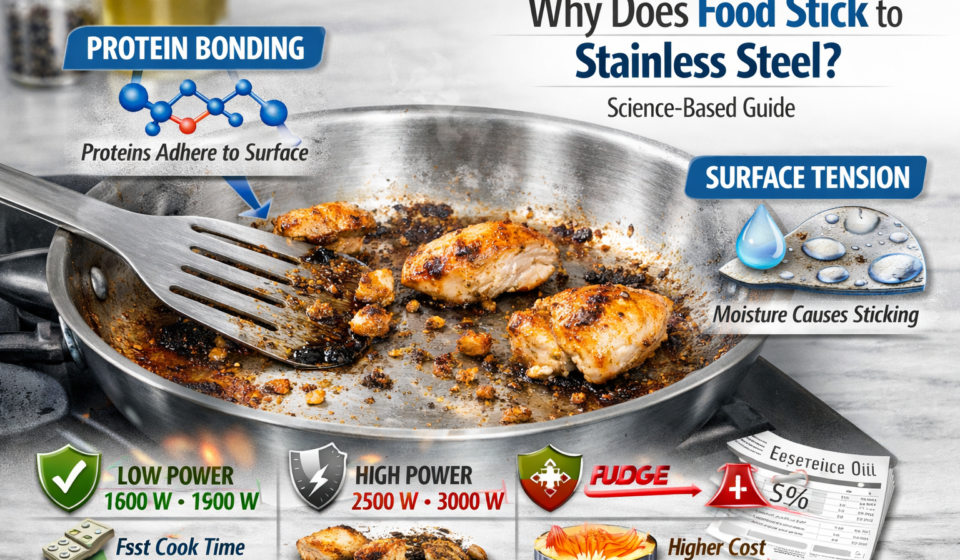
Food sticks to stainless steel because of chemical bonding between proteins and the metal surface.
Here’s what happens:
- Stainless steel has microscopic pores
- When heated, these pores expand
- Food proteins (especially in meat and eggs) bond to the exposed metal
- If the pan is too cold or too hot, the bond becomes stronger
- Oil fills the pores and prevents bonding — but only at the right temperature
Key point:
Sticking is a temperature problem, not a cookware problem.
2. The Science of Protein Bonding
Proteins in food — especially meat, fish, and eggs — are naturally “sticky” when they hit a dry metal surface.
Proteins stick when:
- The pan is too cold
- The pan is overheated
- There isn’t enough oil
- The oil isn’t hot enough
- The food is wet
Proteins release when:
- The pan reaches the correct temperature
- A crust forms
- Moisture evaporates
- The Maillard reaction begins
This is why food often releases on its own after a minute or two — the chemical bond breaks naturally once browning begins.
3. The #1 Cause of Sticking: Wrong Pan Temperature
Stainless steel has a narrow “sweet spot” for cooking.
Too cold → food sticks immediately
Oil hasn’t filled the pores yet.
Too hot → oil burns and becomes sticky
Burned oil polymerizes and creates a glue‑like layer.
Just right → food releases naturally
Oil forms a barrier between the food and the steel.
4. The Water Drop Test (Professional Method)
This is the most reliable way to know when stainless steel is ready.
How to do it:
- Heat the pan on medium
- Flick a few drops of water into the pan
- Watch what happens
If water:
- Sizzles and evaporates instantly → pan is too cold
- Splits into tiny beads → almost ready
- Forms a single mercury‑like ball that glides around → perfect temperature
This is called the Leidenfrost effect, and it means the pan is ready for oil and food.
5. Why Oil Temperature Matters
Oil behaves differently depending on temperature.
Cold oil
- Sinks into pores
- Doesn’t coat the surface
- Allows proteins to bond
Hot oil
- Floats above the steel
- Creates a barrier
- Prevents sticking
Burned oil
- Turns brown
- Polymerizes
- Creates a sticky residue
Rule:
Heat the pan first → then add oil → then add food.
6. Why Moisture Causes Sticking
Water and oil don’t mix — and water lowers the surface temperature of the pan.
Wet food = sticking
- Pat meat dry
- Drain tofu
- Dry vegetables after washing
Moisture creates steam pockets that disrupt the oil barrier.
7. Why Eggs Stick to Stainless Steel
Eggs are almost pure protein — the stickiest food you can cook.
Eggs stick when:
- The pan is too cold
- The pan is too hot
- Not enough oil or butter is used
- The pan isn’t preheated properly
How to prevent sticking:
- Preheat the pan
- Add butter or oil
- Lower heat before adding eggs
- Let the eggs set before moving them
8. Why Meat Sticks — and Why It Releases on Its Own
When meat hits the pan:
- Proteins bond to the steel
- Moisture evaporates
- A crust begins to form
- Once browned, the crust naturally releases
If you try to flip too early → sticking
If you wait for the crust → perfect release
This is why professional chefs say:
“If it’s sticking, it’s not ready to flip.”
9. Common Mistakes That Cause Sticking
9.1 Using high heat too early
Burns oil and creates sticky residue.
9.2 Adding oil to a cold pan
Oil sinks into pores instead of coating the surface.
9.3 Moving food too soon
Breaks the crust before it forms.
9.4 Using spray oils
They burn quickly and leave sticky polymers.
9.5 Not cleaning the pan properly
Residue builds up and becomes tacky.
10. How to Make Stainless Steel Nonstick (The Right Way)
Step 1: Preheat the pan on medium
Use the water drop test.
Step 2: Add oil and heat until shimmering
Oil should ripple, not smoke.
Step 3: Add dry food
Moisture = sticking.
Step 4: Let the food release naturally
Don’t force it.
Step 5: Adjust heat as needed
Stainless steel responds quickly.
11. How to Clean Stainless Steel to Prevent Future Sticking
11.1 Use Bar Keepers Friend for deep cleaning
Removes polymerized oil.
11.2 Deglaze after cooking
Water or broth lifts stuck bits.
11.3 Avoid abrasive scrubbers
They scratch the surface.
11.4 Remove burnt oil immediately
Burnt residue = future sticking.
12. When Sticking Is a Sign of a Problem
12.1 Warped pan
Uneven heat = sticking.
12.2 Burned oil buildup
Creates a sticky layer.
12.3 Cheap thin stainless steel
Hot spots cause sticking.
12.4 Damaged surface
Deep scratches can trap food.
Conclusion
Food sticks to stainless steel because of protein bonding, temperature issues, and oil behavior — not because the pan is flawed. Once you understand the science, stainless steel becomes one of the most reliable, high‑performance cookware materials in your kitchen. With proper preheating, the right amount of oil, and good cleaning habits, stainless steel can perform like a nonstick pan while delivering superior searing, browning, and durability.