Skip to content
Modern Kitchen Cookware Modern Kitchen Cookware

My WordPress Blog

Modern Kitchen Cookware Modern Kitchen Cookware

My WordPress Blog

  • Home
  • Air Fryers
  • Buying Guides
  • Brand Reviews
  • Cookware Sets
  • Kitchen Gadgets
  • Kitchen Energy & Safety
  • Non‑Stick Pans
  • Stainless Steel
  • Home
  • Air Fryers
  • Buying Guides
  • Brand Reviews
  • Cookware Sets
  • Kitchen Gadgets
  • Kitchen Energy & Safety
  • Non‑Stick Pans
  • Stainless Steel
Close

Search

  • Home
  • Air Fryers
  • Buying Guides
  • Brand Reviews
  • Cookware Sets
  • Kitchen Gadgets
  • Kitchen Energy & Safety
  • Non‑Stick Pans
  • Stainless Steel
Subscribe
Home/Buying Guides/The Beginner’s Guide to Saucier Pans: Do You Really Need One?
Buying Guides

The Beginner’s Guide to Saucier Pans: Do You Really Need One?

By Jake
7 Min Read

Table of Contents

Toggle
  • The Beginner’s Guide to Saucier Pans: Do You Really Need One?
    • The Anatomy of the Saucier vs. The Traditional Saucepan
      • 1. The Traditional Saucepan: Rigid Angles
      • 2. The Modern Saucier: Continuous Curves
    • The Physics of Cooking: Why Curves Matter
      • Advantage 1: Elimination of the “Dead Zone”
      • Advantage 2: Optimized Reduction Velocity
      • Advantage 3: Effortless Tossing and Emulsification
    • Culinary Use-Cases: Where the Saucier Shines
      • 1. Delicate Emulsified Sauces
      • 2. Perfect Risotto and Polenta
      • 3. Confectionery and Pastry Creams
    • Buying Guide: What to Look For in a Saucier Pan
      • 1. Demand Fully Clad Multi-Ply Construction
      • 2. Choose the Right Capacity (The Sweet Spot)
      • 3. Check for a Helper Handle
    • Do You Really Need One? The Final Verdict

The Beginner’s Guide to Saucier Pans: Do You Really Need One?

If you have ever spent time browsing professional culinary catalogs, auditing online cooking courses, or watching professional chefs construct intricate reductions on television, you have likely spotted a unique, curved vessel nestled on their stovetops. To the untrained eye, it looks strikingly similar to a standard saucepan. However, culinary insiders refer to this highly specialized tool by its French name: the saucier.

For decades, the saucier was regarded as an exclusive tool reserved for high-end European restaurant kitchens or dedicated pastry chefs. The average home cook typically defaults to a standard, straight-sided saucepan for boiling grains, warming soups, and making basic sauces.

But as home kitchen design and culinary curiosity continue to evolve, this traditional boundary is dissolving. Home baristas, amateur sauciers, and everyday cooks are asking a fundamental question: What exactly is a saucier pan, how does it differ from a standard saucepan, and do you actually need one to elevate your home cooking?

This comprehensive guide breaks down the physical architecture of the saucier, explores the fluid dynamics that make it superior for delicate cooking, and helps you decide if this tool deserves a permanent spot in your kitchen cabinets.

The Anatomy of the Saucier vs. The Traditional Saucepan

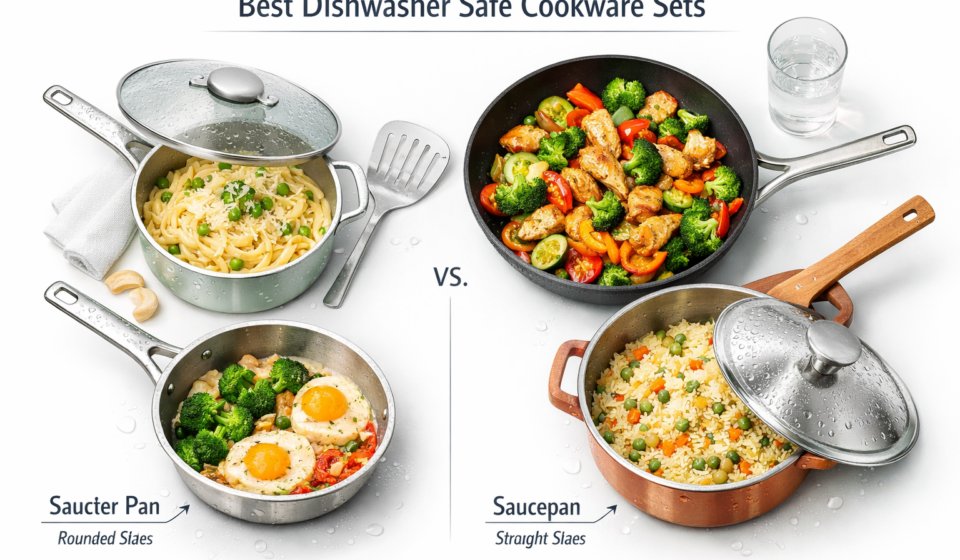
To understand why a saucier pan behaves differently on the stove, you must examine its geometry. While both vessels are designed to hold liquids over a heat source, their structural architectures are radically distinct.

       TRADITIONAL SAUCEPAN                      MODERN SAUCIER PAN
       
          |            |                            |            |
          |            |                            |            |
          |            |                             \          /
          |____________|                              \________/
        [ Sharp 90° Corners ]                    [ Smooth Curved Walls ]

1. The Traditional Saucepan: Rigid Angles

A standard saucepan is essentially a metallic cylinder. It features perfectly vertical side walls that meet a completely flat floor at a sharp, $90^\circ$ angle. While this geometric configuration is highly efficient for holding maximum volume and boiling liquids cleanly, it introduces structural liabilities when you introduce thick, starchy, or dairy-heavy ingredients.

2. The Modern Saucier: Continuous Curves

A saucier pan completely eliminates sharp interior corners. Instead, its walls slope gently outward, cascading down into a smoothly rounded, bowl-shaped basin. The transition from the wall to the floor is a single, uninterrupted curve. Additionally, a saucier typically features a wider, flared top opening relative to its base diameter, giving it an open, bowl-like silhouette.

The Physics of Cooking: Why Curves Matter

The architectural differences between these two pans aren’t just aesthetic choices; they fundamentally alter the thermodynamics and fluid dynamics of your cooking. The saucier’s curved interior offers three major mechanical advantages:

+-------------------------------------------------------------------------+
|                    THE ARCHITECTURAL PERFORMANCE ADVANTAGE              |
+-------------------------------------------------------------------------+
| ADVANTAGE 1: Total Whisk Contact                                        |
|   • The rounded basin perfectly matches the radius of a balloon whisk,  |
|     leaving zero blind spots for ingredients to collect and burn.       |
|                                                                         |
| ADVANTAGE 2: Superior Evaporation Mechanics                             |
|   • The wide, flared rim maximizes surface area exposure to the air,    |
|     speeding up reduction times by up to 30%.                           |
+-------------------------------------------------------------------------+

Advantage 1: Elimination of the “Dead Zone”

When you stir a thick mixture—such as a pastry cream, risotto, or a flour-based roux—inside a traditional saucepan, your spoon, spatula, or whisk cannot physically fit into the sharp $90^\circ$ perimeter corners. This creates a ring-shaped “dead zone.”

Ingredients get trapped in these corners, sit completely still directly over the heat source, quickly overheat, and scorch. Once a sauce burns in the corners, those bitter, black flakes break loose and ruin the flavor profile of your entire dish.

Because a saucier features a continuously curved basin, a flexible silicone spatula or a rounded balloon whisk can glide smoothly across every millimeter of the interior surface. There are absolutely no blind spots where food can hide and burn, allowing for complete, stress-free temperature control.

Advantage 2: Optimized Reduction Velocity

Sauces rely heavily on evaporation to concentrate flavors and achieve a rich, velvety texture. A traditional saucepan traps moisture because its vertical walls force evaporating steam to travel straight up a narrow chimney, often condensing on the cool upper walls and dripping back into the food.

A saucier’s flared, wide-mouth rim significantly increases the surface area of the liquid exposed to the open air. This structural design allows moisture to escape rapidly, reducing your cooking times for complex wine reductions, gravies, and marinades by up to 30%.

Advantage 3: Effortless Tossing and Emulsification

The sloped walls of a saucier act like a mini wok. If you are finishing a pasta dish by tossing the noodles directly inside your sauce, the curved edges guide the food smoothly up and roll it back into the center of the pan without spilling over the side. This motion makes it incredibly easy to build a glossy, restaurant-grade emulsion of pasta water, butter, and cheese.

Culinary Use-Cases: Where the Saucier Shines

While a saucier can easily boil an egg or warm up a can of soup, it transforms into an indispensable powerhouse when tasked with delicate, technically demanding recipes.

+-----------------------------------------------------------------------+
|                    THE CULINARY PERFORMANCE GRID                      |
+-----------------------------------------------------------------------+
| RECIPE CATEGORY       | THE SAUCIER'S PERFORMANCE UTILITY             |
+-----------------------+-----------------------------------------------+
| Emulsified Sauces     | Complete whisk saturation prevents egg        |
| (Hollandaise/Béarnaise)| curdling or separation.                       |
+-----------------------+-----------------------------------------------+
| Starchy Grains        | Rounded floor mirrors the motion of tossing   |
| (Risotto/Polenta)     | starch without tearing delicate grains.       |
+-----------------------+-----------------------------------------------+
| Pastry & Dairy        | Prevents milk solids from scorching along     |
| (Custards/Caramels)   | the floor perimeter.                          |
+-----------------------+-----------------------------------------------+

1. Delicate Emulsified Sauces

Creating a classic Hollandaise, Béarnaise, or a delicate French beurre blanc requires whisking egg yolks or cold butter into a warm liquid matrix. If the mixture overheats for even a second, the proteins will curdle, turning your smooth sauce into scrambled eggs. The saucier allows for constant, high-velocity whisking that keeps the emulsion stable and prevents localized hot spots.

2. Perfect Risotto and Polenta

Risotto requires constant stirring to gently release starches from the arborio rice grains, creating a creamy coating without turning the rice into mush. A saucier accommodates this continuous stirring motion effortlessly. The rice slides smoothly around the curved basin without getting crushed or stuck in corner pockets.

3. Confectionery and Pastry Creams

Making homemade puddings, custards, lemon curds, or melted caramels is notoriously risky on a standard stovetop. The moment milk solids or sugars settle along a sharp corner seam, they begin to smoke and turn bitter. A fully clad saucier pan distributes heat so uniformly across its curved base that sugar caramelizes evenly without scorching.

Buying Guide: What to Look For in a Saucier Pan

If you decide to add a saucier to your kitchen toolkit, don’t just grab the cheapest model on the shelf. Because this pan is designed for precise temperature control, its structural composition is critical.

1. Demand Fully Clad Multi-Ply Construction

Never buy a saucier pan that uses cheap, single-ply metal or a disc-bottom base. Because the walls of a saucier slope outward dramatically, a disc base will leave the flared edges completely cold.

Look for a fully clad tri-ply or 5-ply construction where conductive aluminum is sandwiched between durable stainless steel from the base all the way up to the very rim. This guarantees that the sloped walls heat at the exact same rate as the floor, ensuring your sauce reduces uniformly along the edges.

2. Choose the Right Capacity (The Sweet Spot)

Saucier pans are typically sold in capacities ranging from 1.5 quarts up to 5 quarts. For the vast majority of home kitchens, a 2-to-3-quart saucier is the ideal sweet spot. This size is large enough to construct a family-sized batch of pasta sauce or risotto, yet compact enough to easily manage small, delicate pastry glazes or gravies.

3. Check for a Helper Handle

Because fully clad stainless steel is heavy, a loaded 3-quart saucier can be awkward to lift with one hand. Look for a model that features a primary long handle paired with a smaller “helper handle” on the opposite side. This dual-handle configuration gives you excellent stability and physical leverage when pouring hot, heavy liquids into a serving bowl.

Do You Really Need One? The Final Verdict

+-------------------------------------------------------------------------+
|                           THE DECISION COMPASS                          |
+-------------------------------------------------------------------------+
| YOU NEED A SAUCIER IF:                                                  |
|   • You love making home-cooked sauces, custards, gravies, or risottos. |
|   • You find yourself frequently scorching food in saucepan corners.    |
|   • You appreciate high-performance, responsive clad metal tools.       |
|                                                                         |
| A STANDARD SAUCEPAN IS SUFFICIENT IF:                                   |
|   • Your stovetop cooking is primarily boiling pasta, grains, or water. |
|   • You rely mostly on store-bought, jarred pasta sauces.               |
|   • Kitchen storage space is exceptionally limited.                     |
+-------------------------------------------------------------------------+

To be perfectly honest, you do not strictly need a saucier pan to survive. You can technically cook a risotto or a cream reduction in a standard saucepan if you are incredibly vigilant, use a flexible silicone spatula, and constantly scrape down the $90^\circ$ corner seams to prevent burning.

However, if you view cooking as a rewarding craft rather than a chore—or if you simply want to eliminate the frustration of burned sauces and uneven reductions—the saucier pan is a profound game-changer. It is one of those rare, expertly engineered kitchen tools that immediately improves your cooking technique simply by virtue of its shape.

By upgrading to a fully clad, 2-to-3-quart saucier pan, you will find that cooking delicate, complex meals becomes significantly more relaxed, predictable, and rewarding. It is an investment in culinary precision that will pay dividends across every meal you serve!

Author

Jake

Follow Me
Other Articles
Previous

The Best PFAS-Free Ceramic Cookware Sets for Induction Stoves

Recent Posts

  • The Beginner’s Guide to Saucier Pans: Do You Really Need One?
  • The Best PFAS-Free Ceramic Cookware Sets for Induction Stoves
  • The Best Non-Toxic Air Fryers Equipped with Ceramic Baskets
  • The 5 Best Clad-Stainless Steel Skillets Under $100
  • How Often Should You Actually Replace Your Non-Stick Cookware?

Recent Comments

No comments to show.
  • May 2026
  • April 2026
  • March 2026

Categories

  • Air Fryers
  • Brand Reviews
  • Buying Guides
  • Cookware Sets
  • Kitchen Energy & Safety
  • Kitchen Gadgets
  • Non‑Stick Pans
  • Stainless Steel
  • Uncategorized

Modern Kitchen Cookware
Contact Privacy Policy Terms of Service
Some links on this site may earn a commission at no extra cost to you. This helps support our work and keeps the site running.
© 2026 Modern Kitchen Cookware. All rights reserved.
Copyright 2026 — Modern Kitchen Cookware. All rights reserved. Blogsy WordPress Theme

Powered by
►
Necessary cookies enable essential site features like secure log-ins and consent preference adjustments. They do not store personal data.
None
►
Functional cookies support features like content sharing on social media, collecting feedback, and enabling third-party tools.
None
►
Analytical cookies track visitor interactions, providing insights on metrics like visitor count, bounce rate, and traffic sources.
None
►
Advertisement cookies deliver personalized ads based on your previous visits and analyze the effectiveness of ad campaigns.
None
►
Unclassified cookies are cookies that we are in the process of classifying, together with the providers of individual cookies.
None
Powered by